Texas Dow Employees Credit Union (TDECU), the largest credit union in the Houston area with more than $2 billion in assets, will pay $15 million over 10-years for the naming rights to the new University of Houston Football Stadium.
The new stadium will be called TDECU Stadium.
The deal includes a TDECU suite on the 50-yard line and discount tickets for TDECU employees and members.
Read the story.
Friday, July 11, 2014

Thursday, July 10, 2014
Should the Wealthy Get Taxpayer Subsidized Financial Services?
Gina Ragusa, writing a column on Credit Union Online, asked the following question: "Should the Wealthy Be Denied Credit Union Membership?"
The more relevant policy question is should the wealthy get taxpayer subsidized financial services?
Credit unions are tax exempt because they are meant to meet the financial needs of consumers, especially individuals of modest means. This is the public policy rationale for the credit union tax exemption and was reaffirmed by Congress in 1998.
Unfortunately, this tax exemption is poorly targeted. Both people of means and of modest means are recipients of this taxpayer subsidy with the largest portion of the tax exemption accruing to wealthier credit union members.
This would indicate that credit unions are a poor delivery vehicle of this taxpayer subsidy, thus undermining the policy rationale for the tax exemption.
Policymakers would get more bang for the buck by repealing the credit union tax exemption and directly targeting the tax subsidy at people of modest means.
If the tax exemption was repealed, there would not be any reason to debate whether the wealthy should be credit union members. No one would care.
The more relevant policy question is should the wealthy get taxpayer subsidized financial services?
Credit unions are tax exempt because they are meant to meet the financial needs of consumers, especially individuals of modest means. This is the public policy rationale for the credit union tax exemption and was reaffirmed by Congress in 1998.
Unfortunately, this tax exemption is poorly targeted. Both people of means and of modest means are recipients of this taxpayer subsidy with the largest portion of the tax exemption accruing to wealthier credit union members.
This would indicate that credit unions are a poor delivery vehicle of this taxpayer subsidy, thus undermining the policy rationale for the tax exemption.
Policymakers would get more bang for the buck by repealing the credit union tax exemption and directly targeting the tax subsidy at people of modest means.
If the tax exemption was repealed, there would not be any reason to debate whether the wealthy should be credit union members. No one would care.
Wednesday, July 9, 2014
Cornerstone Community FCU Buys Naming Rights to Ice Arena, Terms Not Disclosed
Cornerstone Community Federal Credit Union (Lockport, NY) has signed a 12-year naming rights deal with Lockport Ice Arena & Sports Center Inc.
The new 93,500 square foot arena will be called Cornerstone CFCU Arena. The agreement includes "exclusive exterior facility naming rights, interior and exterior signage, on-site ATM presence and use of the facility on select Cornerstone member nights."
The terms of the deal were not disclosed.
However, shouldn't credit unions be required to disclose the terms of the deal?
After all, credit unions are receiveing a valuable benefit from the American taxpayers in the form of their preferential tax treatment.
Read the story.
The new 93,500 square foot arena will be called Cornerstone CFCU Arena. The agreement includes "exclusive exterior facility naming rights, interior and exterior signage, on-site ATM presence and use of the facility on select Cornerstone member nights."
The terms of the deal were not disclosed.
However, shouldn't credit unions be required to disclose the terms of the deal?
After all, credit unions are receiveing a valuable benefit from the American taxpayers in the form of their preferential tax treatment.
Read the story.
Tuesday, July 8, 2014
No Corporate Separateness between CUs and Association
Eli Lilly FCU (Indianapolis, IN) and Inova FCU (Elkhart, IN) are using an association, Tru Direction, to evade field of membership limitations.
While Inova includes Tru Direction in its list of organizations that allow you to join the credit union, Eli Lilly FCU is blatantly advertising that this association can be used to qualify people for credit union membership, who otherwise are not able to join the credit union.
On Eli Lilly FCU's website, the credit union writes:
"If you are not affiliated with any of the above organizations, you can STILL become a member by joining Tru Direction, a non-profit association dedicated to financial literacy."
You can join Tru Direction by making a one-time payment of $5.
But there does not appear to be any corporate separateness between Tru Direction and these two credit unions.
The Board of Directors of Tru Direction is totally comprised of employees from the two credit unions.
A further indication that there is a lack of corporate separateness between the credit unions and the association is that the only membership benefit listed on Tru Direction's website is being eligible to join any of our affiliate credit unions.
While Inova includes Tru Direction in its list of organizations that allow you to join the credit union, Eli Lilly FCU is blatantly advertising that this association can be used to qualify people for credit union membership, who otherwise are not able to join the credit union.
On Eli Lilly FCU's website, the credit union writes:
"If you are not affiliated with any of the above organizations, you can STILL become a member by joining Tru Direction, a non-profit association dedicated to financial literacy."
You can join Tru Direction by making a one-time payment of $5.
But there does not appear to be any corporate separateness between Tru Direction and these two credit unions.
The Board of Directors of Tru Direction is totally comprised of employees from the two credit unions.
- Matt Snively, Board Chair, is a SVP, Wealth Mgmt & Strategic Projects at Eli Liily FCU;
- Vicki Spicher, Vice Chair, is VP of Operations at Inova FCU;
- Lisa Markland, Treasurer, works in Human Resources at Eli Lilly FCU; and
- Claire Kellems, Secretary, is an Executive Assistant at Inova FCU.
A further indication that there is a lack of corporate separateness between the credit unions and the association is that the only membership benefit listed on Tru Direction's website is being eligible to join any of our affiliate credit unions.
Thursday, July 3, 2014
NCUA: Credit Union Regulator or Cheerleader?
Once again, the National Credit Union Administration (NCUA) has confused its role as a credit union regulator for being the head cheerleader from the credit union industry.
On July 2 NCUA Board member Michael Fryzel wrote an opinion piece responding to opinion expressed by Frank Keating, the president and CEO of the American Bankers Association, about NCUA chartering a credit union to serve pro athletes.
However NCUA Board member Fryzel never addresses the issue about a credit union for pro athletes. Maybe that would be too hard to explain.
Instead he writes about how wonderful credit unions are and how people of means and of modest means prefer credit unions.
Tell that to the poor guy in Florida who got the run around from Achieva CU and Fryzel's agency. See my June 21 blog post.
He then launches into the credit union lobby's litany that credit unions offer better rates, better service, lower fees, and greater convenience. Yada, Yada, Yada.
This opinion piece is what I would expect from credit union trade associations, but is inappropriate from a regulator.
Read the Fryzel opinion piece.
On July 2 NCUA Board member Michael Fryzel wrote an opinion piece responding to opinion expressed by Frank Keating, the president and CEO of the American Bankers Association, about NCUA chartering a credit union to serve pro athletes.
However NCUA Board member Fryzel never addresses the issue about a credit union for pro athletes. Maybe that would be too hard to explain.
Instead he writes about how wonderful credit unions are and how people of means and of modest means prefer credit unions.
Tell that to the poor guy in Florida who got the run around from Achieva CU and Fryzel's agency. See my June 21 blog post.
He then launches into the credit union lobby's litany that credit unions offer better rates, better service, lower fees, and greater convenience. Yada, Yada, Yada.
This opinion piece is what I would expect from credit union trade associations, but is inappropriate from a regulator.
Read the Fryzel opinion piece.
Wednesday, July 2, 2014
45 Percent of CUs Reported Higher Earnings Than A Year Ago
For the first quarter of 2014, 2997 credit unions reported higher net income than for the same time period in 2013.
Slightly fewer credit unions, 2,965, reported improved profitability year-over-year, when measured by return on average assets (ROA).
The following table shows the number of credit unions by asset size reporting higher earnings or ROA for the first quarter of 2014 compared to the same time period last year.

Slightly fewer credit unions, 2,965, reported improved profitability year-over-year, when measured by return on average assets (ROA).
The following table shows the number of credit unions by asset size reporting higher earnings or ROA for the first quarter of 2014 compared to the same time period last year.

Tuesday, July 1, 2014
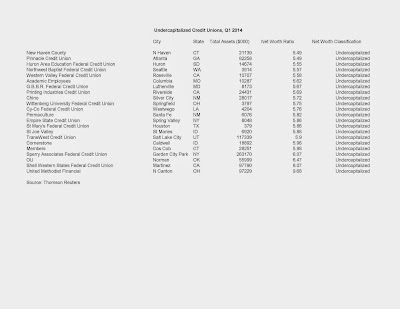
Undercapitalized CUs, Q1 2014
Sixty-three credit unions were undercapitalized at the end of the first quarter of 2014. This was an increase of two credit unions from the end of 2013; but down 31 credit unions from a year ago.
The 63 undercapitalized credit unions reported slightly more than $3.5 billion in assets at the end of the first quarter of 2014.
Four credit unions were critically undercapitalized. Another 13 credit unions were significantly undercapitalized.
Although four credit unions had net worth leverage ratios in excess of 6 percent, their risk-based net worth ratios indicated that they were undercapitalized.

The 63 undercapitalized credit unions reported slightly more than $3.5 billion in assets at the end of the first quarter of 2014.
Four credit unions were critically undercapitalized. Another 13 credit unions were significantly undercapitalized.
Although four credit unions had net worth leverage ratios in excess of 6 percent, their risk-based net worth ratios indicated that they were undercapitalized.


Subscribe to:
Posts (Atom)
