A Call Report change for the fourth quarter of 2019 by the National Credit Union Administration could adversely impact the net worth of some credit unions that have acquired a bank.
The NCUA changed line 7 of its PCA Worksheet (see page 56 of the Call Report Instructions) dealing with Adjusted Retained Earnings acquired through Business Combinations.
NCUA in the fourth quarter wrote in its Call Report instructions that this provision only applies to "business combinations with another credit union. This provision does not extend to a credit union that acquires a bank through merger."
This change will hit the net worth for any credit union that had included adjusted retained earnings from a bank merger in its net worth.
For example, IBM Southeast Employees Credit Union (Delray Beach, FL) saw a $31 million decline in its net worth between the third and fourth quarters.
Also, this Call Report change may affect the number of credit union deals for banks going forward.
According to Peter Duffy, Managing Director at Piper Sandler, "we believe this change, while not surprising, will result in fewer and smaller deals."
However, Michael Bell, who is a lawyer at Howard and Howard and has done a majority of bank mergers into credit unions, said: "None of the transactions I have been working on have been negatively affected by this Call Report change."
Bell further stated, "Personally I think the change in treatment is mathematically incorrect but we continue to plow ahead."
Showing posts with label Net Worth. Show all posts
Showing posts with label Net Worth. Show all posts
Monday, February 3, 2020

Friday, November 15, 2019
Schools Financial's Merger Notice
Beyond the usual happy talk about how the merger will benefit credit union members, the merger notice of Schools Financial Credit Union (Sacramento, CA) includes information about merger-related compensation and distribution of net worth to members.
Schools Financial Credit Union is proposing to merge with Schoolsfirst Federal Credit Union (Santa Ana, CA).
First, the credit union states that a vote for the merger will result in an up to $4 million special dividend distribution from net worth to the credit union's members. The distribution will take place on a one-time (pro-rata) basis, with individual dividends being calculated based on average month-end deposit balances in the six (6) month period from June 1, 2019 to November 30, 2019.
Second, the notice disclosed the merger-related compensation for five employees of Schools Financial. Tim Marriott, President/CEO of Schools Financial CU, could earn up to a maximum $8,011,532 in merger-related compensation. However, the notice states that the the likely amount of compensation could be significantly lower.
Also, all employees of Schools Financial Credit Union, except Mr. Marriott, are being offered retention bonuses to help ensure a smooth transition and successful integration of the merger.
The date of the member's vote is December 12, 2019.
Merger Notice.
Schools Financial Credit Union is proposing to merge with Schoolsfirst Federal Credit Union (Santa Ana, CA).
First, the credit union states that a vote for the merger will result in an up to $4 million special dividend distribution from net worth to the credit union's members. The distribution will take place on a one-time (pro-rata) basis, with individual dividends being calculated based on average month-end deposit balances in the six (6) month period from June 1, 2019 to November 30, 2019.
Second, the notice disclosed the merger-related compensation for five employees of Schools Financial. Tim Marriott, President/CEO of Schools Financial CU, could earn up to a maximum $8,011,532 in merger-related compensation. However, the notice states that the the likely amount of compensation could be significantly lower.
Also, all employees of Schools Financial Credit Union, except Mr. Marriott, are being offered retention bonuses to help ensure a smooth transition and successful integration of the merger.
The date of the member's vote is December 12, 2019.
Merger Notice.
Thursday, October 3, 2019
Secondary Capital Up 10.5 Percent During the 1st Half of 2019
Low-income credit unions added secondary capital during the first six months of 2019.
Sixty-eight credit unions have $292.1 million in subordinated debt that counted as net worth at the end of June 2019.
This is up from $264.8 million at the end of 2018.

The following table shows the 10 credit unions holding the most secondary capital.

Six credit unions reported that more than half of their net worth was from secondary capital. At Hope FCU (Jackson, MS), 75.3 percent of its net worth was in the form of subordinated debt.
The other credit unions reporting that at least half of their new worth was from subordinated debt were:
Sixty-eight credit unions have $292.1 million in subordinated debt that counted as net worth at the end of June 2019.
This is up from $264.8 million at the end of 2018.

The following table shows the 10 credit unions holding the most secondary capital.

Six credit unions reported that more than half of their net worth was from secondary capital. At Hope FCU (Jackson, MS), 75.3 percent of its net worth was in the form of subordinated debt.
The other credit unions reporting that at least half of their new worth was from subordinated debt were:
- LCO FCU (WI), 69.4 percent;
- Hill District FCU (PA), 62.8 percent;
- Self-Help FCU (CA), 58.9 percent;
- Syracuse Cooperative FCU (NY), 57.8 percent; and
- Toledo Urban FCU (OH), 50.1 percent.
Friday, July 13, 2018
Subordinated Debt at LICUs Up 57 Percent, Since the End of 2016
Since the end of 2016, subordinated debt counting as net worth has increased by almost 57 percent or $84.4 million.
As of March 2018, total subordinated debt placed with low-income credit unions (LICUs) was $232.8 million. This is up from $148.4 million at the end of 2016.

A number of large LICUs have issued subordinated debt (the dollar amount in parentheses) since the end of 2016, including Advia Credit Union ($5 million), Self-Help Credit Union ($13 million), Self-Help FCU ($5 million), Carter FCU ($6 million), Jefferson Financial FCU ($11,597), and Notre Dame FCU ($12 million).
Carter FCU's issuance of subordinated debt was partially used to repurchase subordinated debt issued from the U.S. Treasury Department as part of the Community Development Capital Initiative.
The following table lists the 10 LICUs holding the most subordinated debt as of March 31, 2018.

It is my belief that this trend of large LICUs issuing subordinated debt will continue.
As of March 2018, total subordinated debt placed with low-income credit unions (LICUs) was $232.8 million. This is up from $148.4 million at the end of 2016.

A number of large LICUs have issued subordinated debt (the dollar amount in parentheses) since the end of 2016, including Advia Credit Union ($5 million), Self-Help Credit Union ($13 million), Self-Help FCU ($5 million), Carter FCU ($6 million), Jefferson Financial FCU ($11,597), and Notre Dame FCU ($12 million).
Carter FCU's issuance of subordinated debt was partially used to repurchase subordinated debt issued from the U.S. Treasury Department as part of the Community Development Capital Initiative.
The following table lists the 10 LICUs holding the most subordinated debt as of March 31, 2018.

It is my belief that this trend of large LICUs issuing subordinated debt will continue.
Monday, March 12, 2018
Notre Dame FCU's Highly Redacted Application for Secondary Capital
Notre Dame Federal Credit Union (Notre Dame, IN) issued $12 million in secondary capital with a maturity of 10-years during the fourth quarter 2017, according to its secondary capital application.
A Freedom of Information Act (FOIA) obtained copies of highly redacted initial and revised applications of the credit union and a copy of the National Credit Union Administration's approval letter.
The credit union stated that the secondary capital will be used to expand deposit and credit services of its members and its communities without curtailing expected future growth of the credit union. It will also assist the credit union in providing mission-related loans, such as zero percent holiday loans up to $1,000, favorable rates for first-time car buyer, and loans for home/appliance repairs up to $5,000.
The application redacts information on the ratio of qualified secondary capital to regular reserves plus retained earnings in 2017, but also the ratio in 2027 at maturity. However at the end of 2017, the ratio of qualified secondary capital to regular reserves plus retained earnings was 27.76 percent.
The credit union further stated that the issuance of secondary capital will strengthen its capital base. With the injection of secondary capital, the credit union's net worth ratio went from 8.06 percent at the end of the third quarter of 2017 to 9.74 percent at the end of 2017.
The National Credit Union Administration (NCUA) wanted to know how the credit union will repay its secondary capital at maturity. The credit union stated it would use liquid accounts at correspondent institutions and its available lines of credit. However, several lines of the application were redacted. This might suggest that the credit union will issue new secondary capital to repay maturing secondary capital.
The NCUA redacted information on how Notre Dame FCU will offset the cost of secondary capital. Also, there was no information on the cost of the secondary capital.
A Freedom of Information Act (FOIA) obtained copies of highly redacted initial and revised applications of the credit union and a copy of the National Credit Union Administration's approval letter.
The credit union stated that the secondary capital will be used to expand deposit and credit services of its members and its communities without curtailing expected future growth of the credit union. It will also assist the credit union in providing mission-related loans, such as zero percent holiday loans up to $1,000, favorable rates for first-time car buyer, and loans for home/appliance repairs up to $5,000.
The application redacts information on the ratio of qualified secondary capital to regular reserves plus retained earnings in 2017, but also the ratio in 2027 at maturity. However at the end of 2017, the ratio of qualified secondary capital to regular reserves plus retained earnings was 27.76 percent.
The credit union further stated that the issuance of secondary capital will strengthen its capital base. With the injection of secondary capital, the credit union's net worth ratio went from 8.06 percent at the end of the third quarter of 2017 to 9.74 percent at the end of 2017.
The National Credit Union Administration (NCUA) wanted to know how the credit union will repay its secondary capital at maturity. The credit union stated it would use liquid accounts at correspondent institutions and its available lines of credit. However, several lines of the application were redacted. This might suggest that the credit union will issue new secondary capital to repay maturing secondary capital.
The NCUA redacted information on how Notre Dame FCU will offset the cost of secondary capital. Also, there was no information on the cost of the secondary capital.
Tuesday, December 12, 2017
HFSC to Mark Up Bill to Repeal NCUA's Risk-based Capital Rule
The House Financial Services Committee (HSFC) is marking up a bill (H.R. 4464) today that would repeal the National Credit Union Administration's risk-based capital rule that is scheduled to go into effect on January 1, 2019.
Given what has transpired with taxi medallion lending credit unions, repealing this risk-based capital rule appears to be a bad idea from a policy perspective.
If this rule was in effect in 2012 or 2013, it would have required these taxi medallion lending credit unions to hold more capital or net worth to offset the risk posed by these credit unions to the National Credit Union Share Insurance Fund.
See the bills that are being marked up.
Given what has transpired with taxi medallion lending credit unions, repealing this risk-based capital rule appears to be a bad idea from a policy perspective.
If this rule was in effect in 2012 or 2013, it would have required these taxi medallion lending credit unions to hold more capital or net worth to offset the risk posed by these credit unions to the National Credit Union Share Insurance Fund.
See the bills that are being marked up.
Tuesday, December 22, 2015
Large CUs' Real Estate Secured Business Loan Exposures
On December 18, the federal banking agencies -- the Federal Deposit Insurance Corporation, the Federal Reserve, and the Office of the Comptroller of the Currency -- issued a statement warning about eased commercial real estate (CRE) loan underwriting and CRE risk management practices that cause “concern.” The federal banking regulators added that supervisors will “continue to pay special attention” to CRE lending in exams in 2016 and reiterated existing interagency guidance on CRE concentration risk.
The National Credit Union Administration did not sign on to this statement; but NCUA may want to sign on to the interagency guidance on CRE concentration risk as real estate secured business loans continue to expand.
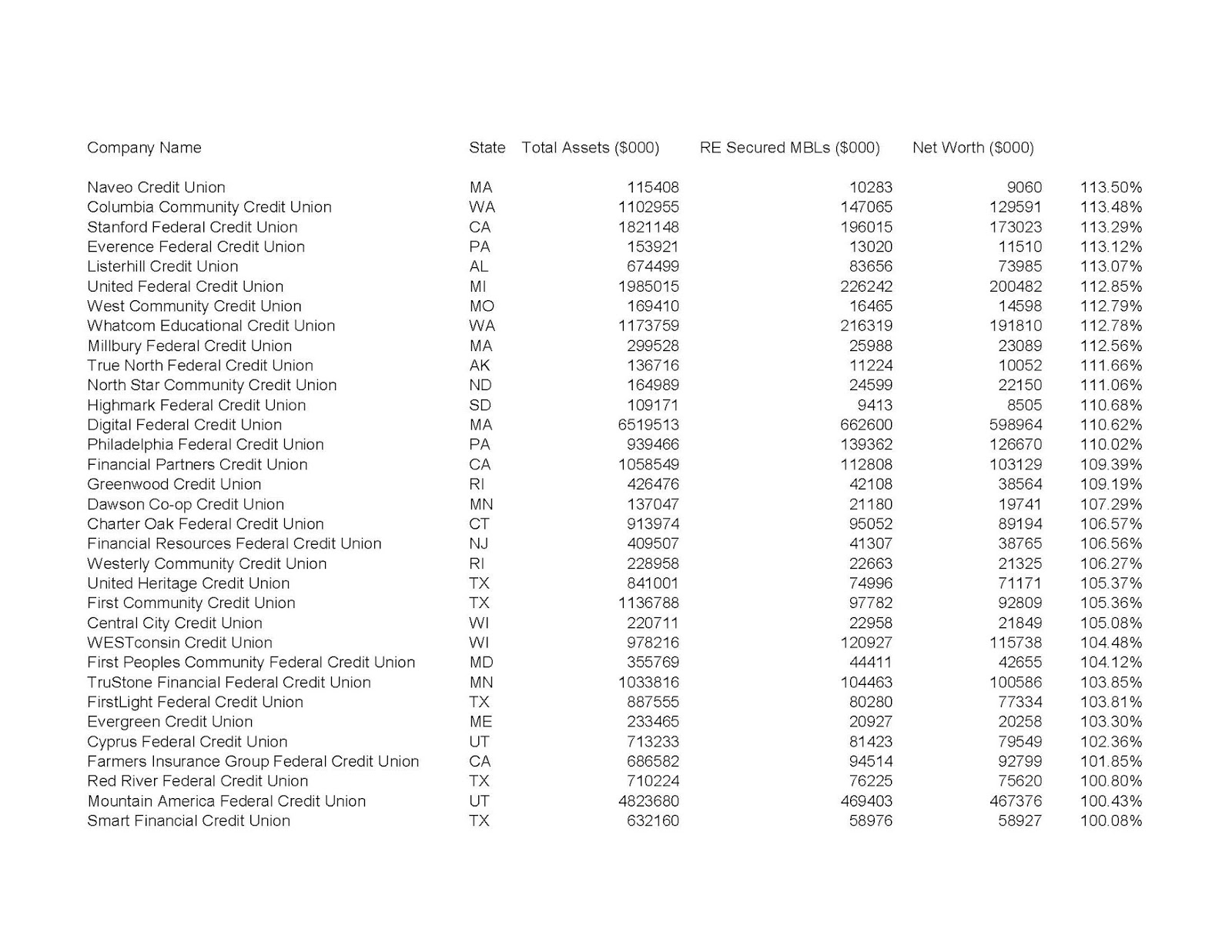
There are 105 credit unions with assets of at least $100 million that have an aggregate exposure to real estate secured business loans that exceeds their net worth at the end of the third quarter.
[Editorial note: I know the 105 credit unions include credit unions that have exposure to farmland loans; but the recent weakness in farm commodity prices will likely have a negative impact on farmland values. So, those credit unions making farmland loans also warrant careful monitoring.]
Thirteen credit unions have a real estate secured business loan to net worth ratio above 200 percent and 5 credit unions -- all state charters -- have a real estate secured business loan to net worth ratio in excess of 300 percent.
The two credit unions with the greatest net worth exposure to real estate secured business loans are involved in church financing. Evangelical Christian Credit Union (Brea, CA) has the greatest percentage of its net worth exposed to real estate secured business loans at 907.24 percent. America's Christian Credit Union (Glendora, CA) has the next largest exposure at 532.4 percent.
The following tables provides info on credit unions with real estate secured business loan exposures of at least 100 percent of net worth.


Read the statement.
The National Credit Union Administration did not sign on to this statement; but NCUA may want to sign on to the interagency guidance on CRE concentration risk as real estate secured business loans continue to expand.
There are 105 credit unions with assets of at least $100 million that have an aggregate exposure to real estate secured business loans that exceeds their net worth at the end of the third quarter.
[Editorial note: I know the 105 credit unions include credit unions that have exposure to farmland loans; but the recent weakness in farm commodity prices will likely have a negative impact on farmland values. So, those credit unions making farmland loans also warrant careful monitoring.]
Thirteen credit unions have a real estate secured business loan to net worth ratio above 200 percent and 5 credit unions -- all state charters -- have a real estate secured business loan to net worth ratio in excess of 300 percent.
The two credit unions with the greatest net worth exposure to real estate secured business loans are involved in church financing. Evangelical Christian Credit Union (Brea, CA) has the greatest percentage of its net worth exposed to real estate secured business loans at 907.24 percent. America's Christian Credit Union (Glendora, CA) has the next largest exposure at 532.4 percent.
The following tables provides info on credit unions with real estate secured business loan exposures of at least 100 percent of net worth.


Read the statement.
Friday, December 18, 2015
A.E.A. FCU Returned to Its Members
Five years after placing A.E.A. Federal Credit Union of Yuma, Arizona into conservatorship, the National Credit Union Administration returned control of A.E.A. Federal Credit Union to its members.
According to its September 2015 call report, credit union was counting $12.8 million in subordinated debt as net worth, which is highly likely Section 208 assistance from the National Credit Union Share Insurance Fund. Without this section 208 assistance the credit union would be critically undercapitalized.
A.E.A. FCU is the second credit union to emerge from conservatorship this year. The other credit union was Keys FCU (Key West, FL).
Read the story.
According to its September 2015 call report, credit union was counting $12.8 million in subordinated debt as net worth, which is highly likely Section 208 assistance from the National Credit Union Share Insurance Fund. Without this section 208 assistance the credit union would be critically undercapitalized.
A.E.A. FCU is the second credit union to emerge from conservatorship this year. The other credit union was Keys FCU (Key West, FL).
Read the story.
Tuesday, July 7, 2015
Raising the MBL Cap to 17.5 Percent?
There is a lot of wishful thinking in the credit union community that the National Credit Union Administration (NCUA) through regulatory fiat can raise the member business loan (MBL) cap to 17.5 percent for credit unions with more than $100 million in assets.
According to the Federal Credit Union Act (FCUA), the MBL cap is equal to the lesser of—
(1) 1.75 times the actual net worth of the credit union; or
(2) 1.75 times the minimum net worth required under section 1790d(c)(1)(A) of this title for a credit union to be well capitalized.
The minimum net worth ratio to be well capitalized is 7 percent of assets. Seven percent of assets multiplied by 1.75 equals 12.25 percent of assets.
So, where does the 17.5 percent number come from?
Here is where the wishful thinking occurs.
According to the FCUA, complex credit unions are also subject to a risk-based net worth requirement.
However, NCUA is proposing to replace its risk-based net worth requirement with a risk-based capital requirement. The agency will require a complex credit union to have at least a risk-based capital ratio of 10 percent to be well capitalized. Also, NCUA is proposing to define a complex credit union as an institution with more than $100 million in assets.
According to industry advocates, 1.75 times 10 percent translates into a MBL cap of 17.5 percent.
But there are flies in the ointment with regard to this wishful thinking.
The FCUA links the MBL cap to net worth, not capital. Section 1790d(c)(1)(A) of the FCUA talks about risk-based net worth requirements, not risk-based capital requirements. Furthermore, the components in the numerator of the risk-based capital ratio proposal do not align with the statutory definition of net worth. So, there does not appear to be a legal foundation to use the proposed risk-based capital requirement to determine the MBL cap.
But even if you assume NCUA goes forward, there is still a fly in this ointment. The 10 percent risk-based capital requirement is based upon risk weighted assets, not total assets. So, to be consistent, the MBL limit would equal 17.5 percent of risk weighted assets. As a general rule, risk weighted assets are less than total assets. So, it is likely the 12.25 percent MBL cap would still be binding for most, if not all, complex credit unions.
As I said, this is just wishful thinking on the part of credit unions.
According to the Federal Credit Union Act (FCUA), the MBL cap is equal to the lesser of—
(1) 1.75 times the actual net worth of the credit union; or
(2) 1.75 times the minimum net worth required under section 1790d(c)(1)(A) of this title for a credit union to be well capitalized.
The minimum net worth ratio to be well capitalized is 7 percent of assets. Seven percent of assets multiplied by 1.75 equals 12.25 percent of assets.
So, where does the 17.5 percent number come from?
Here is where the wishful thinking occurs.
According to the FCUA, complex credit unions are also subject to a risk-based net worth requirement.
However, NCUA is proposing to replace its risk-based net worth requirement with a risk-based capital requirement. The agency will require a complex credit union to have at least a risk-based capital ratio of 10 percent to be well capitalized. Also, NCUA is proposing to define a complex credit union as an institution with more than $100 million in assets.
According to industry advocates, 1.75 times 10 percent translates into a MBL cap of 17.5 percent.
But there are flies in the ointment with regard to this wishful thinking.
The FCUA links the MBL cap to net worth, not capital. Section 1790d(c)(1)(A) of the FCUA talks about risk-based net worth requirements, not risk-based capital requirements. Furthermore, the components in the numerator of the risk-based capital ratio proposal do not align with the statutory definition of net worth. So, there does not appear to be a legal foundation to use the proposed risk-based capital requirement to determine the MBL cap.
But even if you assume NCUA goes forward, there is still a fly in this ointment. The 10 percent risk-based capital requirement is based upon risk weighted assets, not total assets. So, to be consistent, the MBL limit would equal 17.5 percent of risk weighted assets. As a general rule, risk weighted assets are less than total assets. So, it is likely the 12.25 percent MBL cap would still be binding for most, if not all, complex credit unions.
As I said, this is just wishful thinking on the part of credit unions.
Thursday, April 16, 2015
Mergers and Net Worth Adjustments
Recently, Pepsico Employees Federal Credit Union (White Plains, NY) was merged into larger USAlliance Federal Credit Union (Rye, NY).
The rationale for the merger was expanded services.
However, what was not disclosed was whether the 3,567 members of Pepsico Employees FCU received any net worth adjustment.
According to the December 2014 call reports, Pepsico Employees FCU had a higher net worth ratio than USAlliance FCU -- 13.95 percent versus 8.57. This is a difference of 538 basis points.
If the combined institution's net worth ratio was maintained at 8.57 percent, then the members of Pepsico Employees FCU should have received approximately $1.92 million net worth payment or slightly more than $65 per $1000 deposited at the credit union.
An e-mail to USAlliance FCU about whether a net worth adjustment was part of the merger agreement was not answered.
I don't know how prevalent such net worth adjustments are when credit unions merge; but if a credit union that merges into another has a higher net worth ratio, then its members should benefit by getting back a portion of the credit union's net worth.
The rationale for the merger was expanded services.
However, what was not disclosed was whether the 3,567 members of Pepsico Employees FCU received any net worth adjustment.
According to the December 2014 call reports, Pepsico Employees FCU had a higher net worth ratio than USAlliance FCU -- 13.95 percent versus 8.57. This is a difference of 538 basis points.
If the combined institution's net worth ratio was maintained at 8.57 percent, then the members of Pepsico Employees FCU should have received approximately $1.92 million net worth payment or slightly more than $65 per $1000 deposited at the credit union.
An e-mail to USAlliance FCU about whether a net worth adjustment was part of the merger agreement was not answered.
I don't know how prevalent such net worth adjustments are when credit unions merge; but if a credit union that merges into another has a higher net worth ratio, then its members should benefit by getting back a portion of the credit union's net worth.
Tuesday, February 10, 2015
NCUA to Propose Raising Small CU Threshold to $100 Million
Larry Fazio, the National Credit Union Administration's Director of the Office of Examination and Insurance, testified today that next week the NCUA Board will propose doubling the small credit union asset size threshold from $50 million to $100 million.
Fazio noted that in January 2013 the NCUA Board raised the small entity asset size threshold from $10 million to $50 million in assets, which nearly doubled the number of credit unions classified as small for purposes of the Regulatory Flexibility Act nearly doubled. Today, 65 percent of all credit unions are covered by the small credit union definition.
Increasing the threshold from $50 million to $100 million would provide regulatory relief for an additional 745 credit unions in future rulemakings and 77 percent of the credit union industry would be defined as a small credit union.
For example, credit unions defined as small credit unions are exempt credit unions from our interest rate risk rule and are not subject to the agency's risk-based net worth requirement.
In addition, Fazio recommended that Congress act to modify the Federal Credit Union Act to permit all federal credit unions to add underserved areas; to expand credit union member business lending (MBL) by raising the MBL cap and exclude 1- to 4-unit, non-owner-occupied residential dwelling from the definition of a member business loan; to allow healthy and well-managed credit unions to issue supplemental capital that will count as net worth; and to grant NCUA the same authority as other bank regulators to supervise third-party vendors.
Read the testimony.
Fazio noted that in January 2013 the NCUA Board raised the small entity asset size threshold from $10 million to $50 million in assets, which nearly doubled the number of credit unions classified as small for purposes of the Regulatory Flexibility Act nearly doubled. Today, 65 percent of all credit unions are covered by the small credit union definition.
Increasing the threshold from $50 million to $100 million would provide regulatory relief for an additional 745 credit unions in future rulemakings and 77 percent of the credit union industry would be defined as a small credit union.
For example, credit unions defined as small credit unions are exempt credit unions from our interest rate risk rule and are not subject to the agency's risk-based net worth requirement.
In addition, Fazio recommended that Congress act to modify the Federal Credit Union Act to permit all federal credit unions to add underserved areas; to expand credit union member business lending (MBL) by raising the MBL cap and exclude 1- to 4-unit, non-owner-occupied residential dwelling from the definition of a member business loan; to allow healthy and well-managed credit unions to issue supplemental capital that will count as net worth; and to grant NCUA the same authority as other bank regulators to supervise third-party vendors.
Read the testimony.
Thursday, December 18, 2014
Low-Income Credit Unions and Secondary Capital
The Federal Credit Union Act allows low-income credit unions to count secondary or supplemental capital as part of their net worth.
Seventy-five credit unions, excluding Texans CU (Richardson, TX) and A.E.A FCU (Yuma, AZ), reported holding uninsured secondary capital accounts as part of their net worth as of the third quarter of 2014.
Twelve credit union as of September reported that over fifty percent of their net worth is in the form of uninsured secondary capital accounts. This includes Self-Help FCU (Durham, NC), which reports 78.18 percent of its net worth is in the form of uninsured secondary capital accounts.
However, should there be a limit on the amount of secondary capital that low-income credit unions can count towards net worth?
As I have previously written, regulators are focused on increasing the amount of high quality capital that financial institutions hold.
Retained earnings are high quality capital, while secondary or supplemental capital is not high quality capital; because it lacks permanence.
With the number of low-income designated credit unions almost doubling since the middle of 2012 and with few low-income credit unions currently exercising this authority, this would be an ideal time for the National Credit Union Administration to revisit its net worth requirements for low-income credit unions.
The goal should be to have a majority of low income credit unions' net worth comprised of permanent, high quality capital.
Seventy-five credit unions, excluding Texans CU (Richardson, TX) and A.E.A FCU (Yuma, AZ), reported holding uninsured secondary capital accounts as part of their net worth as of the third quarter of 2014.
Twelve credit union as of September reported that over fifty percent of their net worth is in the form of uninsured secondary capital accounts. This includes Self-Help FCU (Durham, NC), which reports 78.18 percent of its net worth is in the form of uninsured secondary capital accounts.
However, should there be a limit on the amount of secondary capital that low-income credit unions can count towards net worth?
As I have previously written, regulators are focused on increasing the amount of high quality capital that financial institutions hold.
Retained earnings are high quality capital, while secondary or supplemental capital is not high quality capital; because it lacks permanence.
With the number of low-income designated credit unions almost doubling since the middle of 2012 and with few low-income credit unions currently exercising this authority, this would be an ideal time for the National Credit Union Administration to revisit its net worth requirements for low-income credit unions.
The goal should be to have a majority of low income credit unions' net worth comprised of permanent, high quality capital.
Tuesday, September 16, 2014
Undercapitalized Credit Unions, June 30, 2014
As of June 30, 2014, there were 60 undercapitalized credit unions in the United States.
These undercapitalized credit unions held slightly more than $3.4 billion in assets.
Six credit unions were classified as critically undercapitalized, while 14 credit unions were significantly undercapitalized.
Four credit unions that were classified as undercapitalized had net worth ratios in excess of 6 percent. However, their net worth ratios did not meet the minimum risk-based net worth requirement.


These undercapitalized credit unions held slightly more than $3.4 billion in assets.
Six credit unions were classified as critically undercapitalized, while 14 credit unions were significantly undercapitalized.
Four credit unions that were classified as undercapitalized had net worth ratios in excess of 6 percent. However, their net worth ratios did not meet the minimum risk-based net worth requirement.


Friday, May 16, 2014
Is NCUA Ready to Supervise a Credit Union that Conducts Its Own Stress Test?
The transcript from the April 24 NCUA Board meeting makes it pretty clear that NCUA does not have the staffing or resources to supervise a credit union that conducts its own stress test.
NCUA Chariman Debbie Matz asked Scott Hunt, the head of the Office of National Examinations and Supervision, the following questions.
You have to go to the fourth paragraph of his response to get the answer, which is no.
Scott Hunt said: "So basically it would pull together both personnel resources, information data gathering as well as an investment in software that we don't have today so the short answer on that is no, we are not ready to take this on."
Hunt notes the difference between the FDIC and NCUA with regard to data collection. He states: "The FDIC has accumulated significant bank data over the years through their Call Report. Their Call Reports are hundreds of pages long in comparison to the very high-level data we gather from our credit unions in the 20 to 30 page range." So, the dearth of detailed information is one factor limiting NCUA's preparedness.
Hunt further points out the difference in staff expertise. He states that FDIC has "acquired resources where they possess the skills and expertise," which NCUA does not possess and will need to acquire. He notes that stress tests are not generic exercises and require considerable judgement.
He also says that "[i]t would require an investment in analytical software that we currently don't possess." This would be an additional expense for the agency, if it decides to allow credit unions to conduct their own stress tests.
NCUA Chariman Debbie Matz asked Scott Hunt, the head of the Office of National Examinations and Supervision, the following questions.
"The final rule provides that three years after enactment, a credit union can apply to conduct their own stress test. Does your office have the necessary staffing to supervise that if you agree that a $10 billion credit union at that point can do their own stress test? Are you staffed to handle that?"
You have to go to the fourth paragraph of his response to get the answer, which is no.
Scott Hunt said: "So basically it would pull together both personnel resources, information data gathering as well as an investment in software that we don't have today so the short answer on that is no, we are not ready to take this on."
Hunt notes the difference between the FDIC and NCUA with regard to data collection. He states: "The FDIC has accumulated significant bank data over the years through their Call Report. Their Call Reports are hundreds of pages long in comparison to the very high-level data we gather from our credit unions in the 20 to 30 page range." So, the dearth of detailed information is one factor limiting NCUA's preparedness.
Hunt further points out the difference in staff expertise. He states that FDIC has "acquired resources where they possess the skills and expertise," which NCUA does not possess and will need to acquire. He notes that stress tests are not generic exercises and require considerable judgement.
He also says that "[i]t would require an investment in analytical software that we currently don't possess." This would be an additional expense for the agency, if it decides to allow credit unions to conduct their own stress tests.
Thursday, April 10, 2014
NCUA Clarifies Comment on Supplemental Capital and Risk-Based Capital
NCUA's General Counsel Mike McKenna sent a letter on April 9 to House Financial Services Committee Chairman Hensarling (R-TX0 and Ranking Member Waters (D-CA) clarifying the agency's position on supplemental capital as it relates to its risk-based capital proposal.
During the hearing, Rep. Sherman (D-CA) asked NCUA General Counsel Mike McKenna a series of questions regarding the NCUA's risk-based capital proposal, including one about supplemental capital as it relates to the proposed risk-based capital rule. McKenna stated that NCUA might allow credit unions greater access to supplemental capital as it finalizes the proposed rule.
In the letter, McKenna notes that NCUA has very little authority to establish supplemental or secondary capital for credit unions unless Congress changes the definition of net worth. McKenna states that with the exception of low-income credit unions net worth is limited to retained earnings as defined by generally accepted accounting principles.
McKenna wrote that NCUA will allow low-income credit unions to count supplemental capital as net worth for the purpose of calculating the credit union's risk-based capital ratio.
Below is the letter.


During the hearing, Rep. Sherman (D-CA) asked NCUA General Counsel Mike McKenna a series of questions regarding the NCUA's risk-based capital proposal, including one about supplemental capital as it relates to the proposed risk-based capital rule. McKenna stated that NCUA might allow credit unions greater access to supplemental capital as it finalizes the proposed rule.
In the letter, McKenna notes that NCUA has very little authority to establish supplemental or secondary capital for credit unions unless Congress changes the definition of net worth. McKenna states that with the exception of low-income credit unions net worth is limited to retained earnings as defined by generally accepted accounting principles.
McKenna wrote that NCUA will allow low-income credit unions to count supplemental capital as net worth for the purpose of calculating the credit union's risk-based capital ratio.
Below is the letter.


Thursday, January 30, 2014
Proposed Rule Gives NCUA Discretion to Set Individual CU's Minimum Capital Requirements
While NCUA's proposed risk-based capital rule sets 10.5 percent as the minimum risk-based capital ratio for being classified as well capitalized, Section 702.105 of the proposed rule grants NCUA discretion to require individual credit unions to hold more capital than is required, if NCUA determines that a credit union's capital is or may become inadequate given the circumstances of the credit union.
NCUA noted that the appropriate level of capital cannot be solely determined by a mathematic formula or objective standards; but must include subjective judgement based upon the agency's expertise.
NCUA outlined 10 scenarios where higher capital levels may be warranted.
NCUA noted that the appropriate level of capital cannot be solely determined by a mathematic formula or objective standards; but must include subjective judgement based upon the agency's expertise.
NCUA outlined 10 scenarios where higher capital levels may be warranted.
(1) A credit union is receiving special supervisory attention;
(2) A credit union has or is expected to have losses resulting in capital inadequacy;
(3) A credit union has a high degree of exposure to interest rate risk, prepayment risk, credit risk, concentration risk, certain risks arising from nontraditional activities or similar risks, or a high proportion of off-balance sheet risk;
(4) A credit union has poor liquidity or cash flow;
(5) A credit union is growing, either internally or through acquisitions, at such a rate that supervisory problems are presented that are not adequately addressed by other NCUA regulations or other guidance;
(6) A credit union may be adversely affected by the activities or condition of its CUSOs or other persons or entities with which it has significant business relationships, including concentrations of credit;
(7) A credit union with a portfolio reflecting weak credit quality or a significant likelihood of financial loss, or which has loans or securities in nonperforming status or on which borrowers fail to comply with repayment terms;
(8) A credit union has inadequate underwriting policies, standards, or procedures for its loans and investments;
(9) A credit union has failed to properly plan for, or execute, necessary retained earnings growth, or
(10) A credit union has a record of operational losses that exceeds the average of other similarly situated credit unions; has management deficiencies, including failure to adequately monitor and control financial and operating risks, particularly the risks presented by concentrations of credit and nontraditional activities; or has a poor record of supervisory compliance.
Friday, January 24, 2014
Risk-Based Net Worth Requirement for All CUs with More Than $50 Million in Assets
In a 198 page proposal, the National Credit Union Administration (NCUA) is seeking to apply a new risk-based net worth standard to all credit unions with more than $50 million in assets.
The Federal Credit Union Act requires complex credit unions to be subject to a risk-based net worth requirement.
NCUA justified the proposed revisions by stating that the proposal would more closely align its risk-based capital measures with those used by other banking regulators and the use of a consistent framework for assigning risk-weights would improve the comparison of assets and risk-adjusted capital levels across financial institutions.
Credit unions will need a minimum risk-based capital ratio of 10.5 percent along with a net worth leverage ratio of 7 percent or greater to be considered well capitalized.
To be adequately capitalized, a credit union would need to have a leverage ratio of 6 percent or greater and must also have a risk-based capital ratio of 8 percent or greater.
According to NCUA's analysis, an overwhelming majority of credit unions with more than $50 million in assets would already be in compliance with the proposal, if it was in effect today. Over 90 percent of these credit unions would meet or exceed the minimum risk-based capital requirement under the proposed rule.
Based upon June 2013 financial information, the proposed changes to the risk-based capital measure, if applied immediately, would cause 189 credit unions to experience a decline in their prompt corrective action classification from well capitalized to adequately capitalized and 10 well capitalized credit unions would become undercapitalized.
NCUA estimates that, collectively, the 10 credit unions that would become undercapitalized under the rule if applied immediately would need to retain an additional $63 million in risk-based capital to become adequately capitalized, assuming no other adjustments.
NCUA is providing an online calculator to help federally insured credit unions evaluate the impact of the proposed risk-based capital rule on their institutions.
I will post additional comments regarding the proposed rule in the coming weeks.
The Federal Credit Union Act requires complex credit unions to be subject to a risk-based net worth requirement.
NCUA justified the proposed revisions by stating that the proposal would more closely align its risk-based capital measures with those used by other banking regulators and the use of a consistent framework for assigning risk-weights would improve the comparison of assets and risk-adjusted capital levels across financial institutions.
Credit unions will need a minimum risk-based capital ratio of 10.5 percent along with a net worth leverage ratio of 7 percent or greater to be considered well capitalized.
To be adequately capitalized, a credit union would need to have a leverage ratio of 6 percent or greater and must also have a risk-based capital ratio of 8 percent or greater.
According to NCUA's analysis, an overwhelming majority of credit unions with more than $50 million in assets would already be in compliance with the proposal, if it was in effect today. Over 90 percent of these credit unions would meet or exceed the minimum risk-based capital requirement under the proposed rule.
Based upon June 2013 financial information, the proposed changes to the risk-based capital measure, if applied immediately, would cause 189 credit unions to experience a decline in their prompt corrective action classification from well capitalized to adequately capitalized and 10 well capitalized credit unions would become undercapitalized.
NCUA estimates that, collectively, the 10 credit unions that would become undercapitalized under the rule if applied immediately would need to retain an additional $63 million in risk-based capital to become adequately capitalized, assuming no other adjustments.
NCUA is providing an online calculator to help federally insured credit unions evaluate the impact of the proposed risk-based capital rule on their institutions.
I will post additional comments regarding the proposed rule in the coming weeks.
Wednesday, January 22, 2014
Net Worth Ratio May Not Identify Capital Deficiencies
The net worth ratio may mask capital deficiencies at credit unions, delaying mandatory corrective actions under the prompt corrective action (PCA) framework.
Credit unions hold both capital (net worth) and loan loss reserves for the purpose to absorb losses.
However, looking strictly at the net worth ratio as an indicator for triggering corrective action without examining the adequacy of loan loss reserves may not accurately measure the financial resiliency of credit unions.
In other words, capital deficiencies may be hidden by inadequately funding loan loss allowance accounts relative to the level of nonperforming assets.
The loan loss allowance account is funded by provisions for loan losses. Reducing provisions for loan losses will cause net income to increase, which will increase the amount of net worth for a credit union.
The following example examines the impact on credit unions that are currently well-capitalized, if the loan loss reserves was funded at 100 percent, 75 percent and 50 percent of nonperforming assets plus other real estate owned (OREO).
If loan loss reserves were funded to equal 100 percent of nonperforming assets plus OREO, 96 credit unions that are currently well-capitalized would slip to undercapitalized and another 152 credit unions would go from well-capitalized to adequately-capitalized. (All information is pulled from the September 30, 2013 call report).
If loan loss reserves were funded at 75 percent of nonperforming assets and OREO, 48 well-capitalized credit unions would become undercapitalized and 103 well-capitalized credit unions would become adequately-capitalized.
If loan loss reserves were funded at 50 percent of nonperforming assets plus OREO, we would see 13 credit unions transition from being well-capitalized to undercapitalized and 51 credit unions would switch from being well-capitalized to adequately-capitalized.
Credit unions hold both capital (net worth) and loan loss reserves for the purpose to absorb losses.
However, looking strictly at the net worth ratio as an indicator for triggering corrective action without examining the adequacy of loan loss reserves may not accurately measure the financial resiliency of credit unions.
In other words, capital deficiencies may be hidden by inadequately funding loan loss allowance accounts relative to the level of nonperforming assets.
The loan loss allowance account is funded by provisions for loan losses. Reducing provisions for loan losses will cause net income to increase, which will increase the amount of net worth for a credit union.
The following example examines the impact on credit unions that are currently well-capitalized, if the loan loss reserves was funded at 100 percent, 75 percent and 50 percent of nonperforming assets plus other real estate owned (OREO).
If loan loss reserves were funded to equal 100 percent of nonperforming assets plus OREO, 96 credit unions that are currently well-capitalized would slip to undercapitalized and another 152 credit unions would go from well-capitalized to adequately-capitalized. (All information is pulled from the September 30, 2013 call report).
If loan loss reserves were funded at 75 percent of nonperforming assets and OREO, 48 well-capitalized credit unions would become undercapitalized and 103 well-capitalized credit unions would become adequately-capitalized.
If loan loss reserves were funded at 50 percent of nonperforming assets plus OREO, we would see 13 credit unions transition from being well-capitalized to undercapitalized and 51 credit unions would switch from being well-capitalized to adequately-capitalized.
Monday, January 6, 2014
Publishing Stress Test Results, CU Trades Say Nyet
Credit union trade associations gave a thumbs down to the idea of publicly disclosing the stress test results for credit unions with $10 billion or more in assets.
The Credit Union National Association (CUNA) in its comment letter stated that the public disclosure of stress test results is neither appropriate nor useful for credit unions. CUNA wrote:
In addition, the National Association of State Credit Union Supervisors (NASCUS) believed that results of NCUA’s stress testing should not be disclosed; but rather treated as confidential examination product. NASCUS noted that "the inexperience of the credit union system administering a formal stress testing regulation" and "the uniqueness of credit union structure" were compelling reasons to not publicize the results.
NASCUS echoes NAFCU's position that credit unions do not have investors, so there is no public policy rationale for the dissemination of the stress test results. NASCUS further points out that credit unions can only build capital through retained earnings, which takes time. NASCUS worries that a covered credit union would be stigmatized by a "failed" stress test for some time, which might lead to a run by its members and endanger the National Credit Union Share Insurance Fund.
Interestingly, NASCUS letter makes the case for credit unions to be subject to a higher capital (net worth) requirement than banks. NASCUS states that unlike its bank counterpart, "a cover credit union has limited options available to it to build capital and restructure its balance sheet."
The Credit Union National Association (CUNA) in its comment letter stated that the public disclosure of stress test results is neither appropriate nor useful for credit unions. CUNA wrote:
"We realize that the bank regulators make such information public. However, we do not think such disclosure is appropriate for credit unions. Credit unions already have a number of incentives to avoid risks. This includes limits on how credit unions build capital, limits on activities and investments, and certain membership conditions. A number of mortgage lending credit unions are also concerned that the new mortgage rules, particularly with the emphasis on “qualified mortgages,” may mean they will limit loan offerings for those who do not meet QM requirements.The National Association of Federal Credit Unions (NAFCU) also advised against making public the stress test results. NAFCU wrote:
No one knows for certain what the impact of the disclosure of stress test results would be on covered credit unions. (One good reason in itself not to disclose the results.) It is easy to see, however, that such disclosure could result in self-limiting of services if credit unions fear risk taking will result in a poor showing under the stress testing.
Public disclosure of stress tests may be appropriate for banks, many of which are publicly traded. However, we cannot agree that it is appropriate or useful for credit unions, and we urge NCUA not to pursue this approach."
"[i]f the NCUA insists on pursuing stress testing and capital planning, it should allow credit unions at least two full reporting cycles to evaluate the necessary resources and identify any potential implementation issues. Only after assessing the results from these cycles should the NCUA promulgate final stress testing and capital reporting requirements. The NCUA should also refrain from making a decision regarding public disclosure until after making such assessments. Banking prudential regulators make these results public because this information could be pertinent to the banks’ investors, and therefore, increased transparency is necessary for the public investment markets to function properly. Credit unions on the other hand have members-owners, not investors. Given that there may be potentially sensitive confidential exam information in the stress testing results, the NCUA should not disclose these results without finding of a compelling reason to do so or examining the issue further."
In addition, the National Association of State Credit Union Supervisors (NASCUS) believed that results of NCUA’s stress testing should not be disclosed; but rather treated as confidential examination product. NASCUS noted that "the inexperience of the credit union system administering a formal stress testing regulation" and "the uniqueness of credit union structure" were compelling reasons to not publicize the results.
NASCUS echoes NAFCU's position that credit unions do not have investors, so there is no public policy rationale for the dissemination of the stress test results. NASCUS further points out that credit unions can only build capital through retained earnings, which takes time. NASCUS worries that a covered credit union would be stigmatized by a "failed" stress test for some time, which might lead to a run by its members and endanger the National Credit Union Share Insurance Fund.
Interestingly, NASCUS letter makes the case for credit unions to be subject to a higher capital (net worth) requirement than banks. NASCUS states that unlike its bank counterpart, "a cover credit union has limited options available to it to build capital and restructure its balance sheet."
Friday, November 15, 2013
Fryzel: Goldilocks Risk-Based Capital Requirement
In a speech to the American Association of Credit Union Leagues, NCUA Board Member Michael Fryzel outlined his thoughts regarding risk-based capital requirements for credit unions.
While Fryzel noted that credit unions are not covered by Basel, the capital regime of credit unions is required to be “comparable” to that of the banking industry.
Fryzel's goldilocks moment came when he stated: "I advocate neither an overly stringent nor an overly permissive approach. I advocate “right sizing” NCUA’s risk-based capital rules."
He goes on to state that an undeniable lesson from the financial crisis is that capital needs to be ample, durable, and readily deployable to shore up a balance sheet under duress.
Moreover, the amount of capital (net worth) required by a credit union will ultimately depend on the activities pursued by a credit union.
Read the speech.
While Fryzel noted that credit unions are not covered by Basel, the capital regime of credit unions is required to be “comparable” to that of the banking industry.
Fryzel's goldilocks moment came when he stated: "I advocate neither an overly stringent nor an overly permissive approach. I advocate “right sizing” NCUA’s risk-based capital rules."
He goes on to state that an undeniable lesson from the financial crisis is that capital needs to be ample, durable, and readily deployable to shore up a balance sheet under duress.
Moreover, the amount of capital (net worth) required by a credit union will ultimately depend on the activities pursued by a credit union.
Read the speech.
Subscribe to:
Posts (Atom)