Dan Berger, the chief executive of the National Association of Federally-Insured Credit Unions (NAFCU), is arguing that U.S. economy could be in a recession as soon as the end of 2019.
Appearing on Hill.TV's "Rising", Mr. Berger stated that " [t]he recession could hit end of 2019 — maybe the first quarter of 2020," if a very large bank was to fail.
As background, NAFCU is advocating for the reinstatement of the Glass-Steagall Act, which separated commercial banking from investment banking.
Given Mr. Berger's dire prediction of an imminent recession, the National Credit Union Administration should immediately assess premiums on all federally insured credit unions to ensure that the National Credit Union Share Insurance Fund has adequate resources to resolve credit union failures.
Also by preemptively assessing premiums, this would limit any spike in premium assessments at the very moment that credit unions would have difficulty affording these higher assessments.
Read the story.
Showing posts with label Assessment. Show all posts
Showing posts with label Assessment. Show all posts
Wednesday, September 19, 2018

Friday, October 13, 2017
NCUA Chairman McWatters: Equity Ratio of 1.30 Percent Not Sufficient to Weather 2007-2009 Recession
National Credit Union Administration Chairman McWatters sets the record straight that the National Credit Union Share Insurance Fund's Normal Operating Level of 1.30 percent was not sufficient to weather the 2007-2009 financial crisis and recession.
McWatters stated:
McWatters stated:
"Some in the credit union community contend a 1.30 percent normal operating level has historically been sufficient to address risks to the Share Insurance Fund, including during the 2007–2009 financial crisis. This is simply not true. The very existence of the Stabilization Fund and the fact the NCUA borrowed $5.1 billion from the U.S. Treasury to fund resolution obligations, demonstrates that the credit union community was not prepared to handle the impact of the large losses that resulted from the failure of five federally insured corporate credit unions as a result of the 2007–2009 recession.Hopefully, McWatters' statement puts to rest the false narrative being pushed by certain credit unions and their trade associations that the equity ratio of 1.30 percent for the National Credit Union Share Insurance Fund was adequate.
These corporate credit unions were not some wholly separate and anomalous externality. They were insured credit unions created, funded, and governed by natural-person credit unions. As noted previously, without the Stabilization Fund, all of the equity in the Insurance Fund would have been consumed by these losses.
The corporate system is better regulated now, and much smaller than it used to be. Therefore, the exposure to future losses from corporate credit unions should be significantly reduced. However, one cannot ignore the fact that the Insurance Fund was imperiled by the risk exposure of this portion of the credit union community.
Others contend that the credit union community weathered the financial crisis just fine with the caveat “if you don’t include the corporate credit union losses.” This contention also is not consistent with established historical fact. The number of troubled credit unions, including large institutions, increased materially during the Great Recession. The Share Insurance Fund’s equity ratio fell below 1.20 percent even without the corporate credit union losses. Meaning, the equity ratio fell below 1.20 percent only because of natural-person credit union losses and insured share growth.
The result was two Share Insurance Fund premiums totaling 22.7 basis points or $1.66 billion. The actual decline in the equity ratio from the 2007–2009 severe recession was predominantly the result of the increase in loss reserves for natural-person credit unions, as required under accounting standards applicable to the Insurance Fund and, to a lesser extent, elevated insured share growth. Realized Share Insurance Fund losses were significantly elevated as well. From 2008–2012, 112 natural-person credit unions failed at a cost of $807 million to the Insurance Fund.
Clearly, a 1.30 percent normal operating level for the Share Insurance Fund was not adequate to handle the 2007–2009 severe recession."
Thursday, September 28, 2017
TCCUSF to Close in 2017, NCUSIF NOL Increased to 1.39 Percent
The National Credit Union Administration (NCUA) Board voted to close the Temporary Corporate Credit Union Stabilization Fund (TCCUSF) in 2017.
The funds, property, and other assets and liabilities of the TCCUSF will be transferred to the National Credit Union Share Insurance Fund (NCUSIF) on October 1, 2017.
In addition, the NCUA Board raised the normal operating level (NOL) for NCUSIF from 1.30 percent to 1.39 of insured shares, despite the objection of many credit union commenters.
The NCUA Board spent part of the meeting challenging the false narrative that an NCUSIF equity ratio of 1.30 percent would withstood the financial crisis. The Board presentation noted that even without the corporate credit union losses, the NCUSIF equity ratio in 2009 and 2010 would have fallen below 1.20 percent, the threshold requiring premium assessments. Without the premium assessment, the NCUSIF equity ratio would have dropped to 1.07 percent.
The Board also adopted a policy for setting the normal operating level.
Any change to the normal operating level of more than 1 basis point shall be made only after a public announcement of the proposed adjustment and opportunity for comment. In soliciting comment, the NCUA will issue a public report, including data supporting the proposal.
When setting the normal operating level, the Board will seek to satisfy the following objectives:
The funds, property, and other assets and liabilities of the TCCUSF will be transferred to the National Credit Union Share Insurance Fund (NCUSIF) on October 1, 2017.
In addition, the NCUA Board raised the normal operating level (NOL) for NCUSIF from 1.30 percent to 1.39 of insured shares, despite the objection of many credit union commenters.
The NCUA Board spent part of the meeting challenging the false narrative that an NCUSIF equity ratio of 1.30 percent would withstood the financial crisis. The Board presentation noted that even without the corporate credit union losses, the NCUSIF equity ratio in 2009 and 2010 would have fallen below 1.20 percent, the threshold requiring premium assessments. Without the premium assessment, the NCUSIF equity ratio would have dropped to 1.07 percent.
The Board also adopted a policy for setting the normal operating level.
Any change to the normal operating level of more than 1 basis point shall be made only after a public announcement of the proposed adjustment and opportunity for comment. In soliciting comment, the NCUA will issue a public report, including data supporting the proposal.
When setting the normal operating level, the Board will seek to satisfy the following objectives:
- Retain public confidence in federal share insurance;
- Prevent impairment of the one percent contributed capital deposit; and
- Ensure the Insurance Fund can withstand a moderate recession without the equity ratio declining below 1.20 percent over a five-year period.
Thursday, February 2, 2017
Privately-Insured Credit Unions and Stabilization Fund Rebate Assessment
When the Temporary Corporate Credit Union Stabilization Fund (Stabilization Fund) is closed, credit unions insured by American Share Insurance (ASI) may receive a payment if they have a claim as a depleted member capital holder in a failed corporate credit union recovery. The same would apply for a credit union that switches to a bank charter.
When the Stabilization Fund is closed, the residual assets will be transferred to the National Credit Union Share Insurance Fund (NCUSIF). Priority to the residual assets first goes to depleted member capital holders in failed corporate credit unions. If there is anything leftover after making depleted member capital holder whole, then a rebate will be paid to all National Credit Union-insured credit unions.
According to a National Credit Union Administration (NCUA) spokesperson, "insured status does not apply to recoveries for depleted member capital holders. So a now or future ASI-insured credit union would get a recovery on its depleted member capital if it held such a claim for a failed corporate credit union's estate with a recovery."
However, only credit unions insured by NCUA at the time of the NCUSIF assessment rebate would receive one. No rebates, if any, can come directly from the Stabilization Fund.
That means former NCUSIF-insured credit unions that paid assessments to the Stabilization Fund would not be eligible to receive an assessment rebate.
When the Stabilization Fund is closed, the residual assets will be transferred to the National Credit Union Share Insurance Fund (NCUSIF). Priority to the residual assets first goes to depleted member capital holders in failed corporate credit unions. If there is anything leftover after making depleted member capital holder whole, then a rebate will be paid to all National Credit Union-insured credit unions.
According to a National Credit Union Administration (NCUA) spokesperson, "insured status does not apply to recoveries for depleted member capital holders. So a now or future ASI-insured credit union would get a recovery on its depleted member capital if it held such a claim for a failed corporate credit union's estate with a recovery."
However, only credit unions insured by NCUA at the time of the NCUSIF assessment rebate would receive one. No rebates, if any, can come directly from the Stabilization Fund.
That means former NCUSIF-insured credit unions that paid assessments to the Stabilization Fund would not be eligible to receive an assessment rebate.
Monday, January 9, 2017
NCUA Makes Case for NCUSIF Premium, Says Impact on CUs Will Be Minimal
National Credit Union Administration (NCUA) Chairman Rick Metsger in a January 6, 2017 letter to Rep. Sean Duffy (R -WI) stated "a premium of 3 to 6 basis points would have a minimal impact on credit unions in the aggregate."
Based upon September Call Report data, the impact of a 6 basis point premium assessment would cause:
However, the base case assumption does not assume an economic downturn or the unexpected failure of one or more large credit unions. NCUA's analysis shows that the NCUSIF equity ratio of 1.32 percent would allow the NCUSIF to withstand two consecutive years of stress and still maintain an equity ratio of at least 1.20 percent. Under the Federal Reserve's severe economic stress scenario, the equity ratio would have to be at 1.44 percent to avoid falling below 1.20 percent over a five-year period and an equity ratio of 1.27 percent to keep the NCUSIF equity ratio from falling below 1.00 percent. It should be noted that by statute NCUA must charge a premium if the equity ratio falls below 1.20 percent and if the equity ratio falls below 1 percent, credit unions would be required to expense a portion of its NCUSIF capitalization deposit.
Chairman Metsger further noted that NCUA's operating expenses charged to the NCUSIF would have the smallest impact in altering the trend in the NCUSIF equity ratio. Chairman Metsger wrote that NCUA would have to cut its operating expenses charged to the NCUSIF by 50 percent ($100 million) to increase the NCUSIF equity ratio by 1 basis point. NCUA charges the NCUSIF almost $200 million to fund its current operating budget of $298.2 million.
In addition, the letter stated that credit unions cannot directly receive a rebate from the Temporary Corporate Credit Union Stabilization Fund (TCCUSF). Rather when the TCCUSF is closed, the residual assets will be transferred to the NCUSIF. If the residual assets push the NCUSIF equity ratio above its normal operating level at the end of the calendar year, then insured credit unions could be entitled to a rebate. Based upon information from September 2016, the closure and transfer of the TCCUSF would raise the NCUSIF equity ratio by as much as 15 basis points. However, the agency cautions that closing the TCCUSF early and transferring the corporate system resolution program assets and obligations to the NCUSIF could introduce significant volatility to the NCUSIF equity ratio.
NCUA estimated that the range of a potential TCCUSF assessment rebate would be between $1.9 billion and $2.4 billion. This assessment rebate would be paid out after recoveries are paid to depleted capital holders.
Based upon September Call Report data, the impact of a 6 basis point premium assessment would cause:
- the aggregate net worth ratio to fall 4 basis point to 10.81 percent;
- the average return on average assets would fall from 0.78 percent to 0.73 percent;
- the aggregate cash-to-asset ratio to decline from 8.56 percent to 8.52 percent;
- the number of credit unions reporting negative earnings would rise from 1,174 credit unions to 1,388 credit unions;
- eight credit unions to slip from adequately capitalized to undercapitalized and 12 credit unions would drop from well-capitalized to adequately capitalized; and
- credit union lending would be reduced by 0.04 percent.
However, the base case assumption does not assume an economic downturn or the unexpected failure of one or more large credit unions. NCUA's analysis shows that the NCUSIF equity ratio of 1.32 percent would allow the NCUSIF to withstand two consecutive years of stress and still maintain an equity ratio of at least 1.20 percent. Under the Federal Reserve's severe economic stress scenario, the equity ratio would have to be at 1.44 percent to avoid falling below 1.20 percent over a five-year period and an equity ratio of 1.27 percent to keep the NCUSIF equity ratio from falling below 1.00 percent. It should be noted that by statute NCUA must charge a premium if the equity ratio falls below 1.20 percent and if the equity ratio falls below 1 percent, credit unions would be required to expense a portion of its NCUSIF capitalization deposit.
Chairman Metsger further noted that NCUA's operating expenses charged to the NCUSIF would have the smallest impact in altering the trend in the NCUSIF equity ratio. Chairman Metsger wrote that NCUA would have to cut its operating expenses charged to the NCUSIF by 50 percent ($100 million) to increase the NCUSIF equity ratio by 1 basis point. NCUA charges the NCUSIF almost $200 million to fund its current operating budget of $298.2 million.
In addition, the letter stated that credit unions cannot directly receive a rebate from the Temporary Corporate Credit Union Stabilization Fund (TCCUSF). Rather when the TCCUSF is closed, the residual assets will be transferred to the NCUSIF. If the residual assets push the NCUSIF equity ratio above its normal operating level at the end of the calendar year, then insured credit unions could be entitled to a rebate. Based upon information from September 2016, the closure and transfer of the TCCUSF would raise the NCUSIF equity ratio by as much as 15 basis points. However, the agency cautions that closing the TCCUSF early and transferring the corporate system resolution program assets and obligations to the NCUSIF could introduce significant volatility to the NCUSIF equity ratio.
NCUA estimated that the range of a potential TCCUSF assessment rebate would be between $1.9 billion and $2.4 billion. This assessment rebate would be paid out after recoveries are paid to depleted capital holders.
Thursday, December 22, 2016
Metsger: Contingent Legal Fee Was the Best Available Option
In a December 20th letter to Rep. Mick Mulvaney (R - SC), National Credit Union Administration (NCUA) Chairman Metsger wrote that "the decision to pursue legal action using a contingency fee arrangement was the best available option" for the agency over the failure of five corporate credit unions that had bought faulty mortgage-backed securities.
The letter was in response to a November 21 letter from Rep. Mulvaney.
NCUA has paid more than $1 billion in legal fees on $4.3 billion in recoveries from legal settlements.
In pursuing its contingent fee arrangement, Chairman Metsger stated that NCUA did not have the in-house resources or expertise to independently pursue its legal strategy.
He also noted that the agency lacked resources to hire law firms on a hourly basis. Therefore, an hourly fee arrangement would have required increased assessments on credit unions, which credit unions would have had difficulty paying.
Metsger contended that a contingency fee arrangement insulated credit unions from most expenses, if the lawsuits failed, and provided significant upside benefit to credit unions, if the agency's legal strategy was successful.
Metsger claimed that the agency could not have brought these complex lawsuits without the contingency fee arrangement.
Metsger pointed out that the recoveries from NCUA's lawsuits "enabled the agency to stop assessing credit unions the cost of the repayment of the Stabilization Fund since 2012."
Metsger also stated that the agency created a website for credit unions to get information regarding the legal settlements.
The letter also addressed the agency's efforts to control expenses and to increase budget transparency.
The letter appears below (click on image to enlarge)


The letter was in response to a November 21 letter from Rep. Mulvaney.
NCUA has paid more than $1 billion in legal fees on $4.3 billion in recoveries from legal settlements.
In pursuing its contingent fee arrangement, Chairman Metsger stated that NCUA did not have the in-house resources or expertise to independently pursue its legal strategy.
He also noted that the agency lacked resources to hire law firms on a hourly basis. Therefore, an hourly fee arrangement would have required increased assessments on credit unions, which credit unions would have had difficulty paying.
Metsger contended that a contingency fee arrangement insulated credit unions from most expenses, if the lawsuits failed, and provided significant upside benefit to credit unions, if the agency's legal strategy was successful.
Metsger claimed that the agency could not have brought these complex lawsuits without the contingency fee arrangement.
Metsger pointed out that the recoveries from NCUA's lawsuits "enabled the agency to stop assessing credit unions the cost of the repayment of the Stabilization Fund since 2012."
Metsger also stated that the agency created a website for credit unions to get information regarding the legal settlements.
The letter also addressed the agency's efforts to control expenses and to increase budget transparency.
The letter appears below (click on image to enlarge)


Thursday, December 15, 2016
Rep. Duffy Seeks Answers to Impact of NCUSIF Premium on CU Lending and Operations
In a letter to National Credit Union Administration (NCUA) Chairman Rick Metsger, Rep. Sean Duffy (R - WI) requested that the NCUA Board carefully assess the impact of a National Credit Union Share Insurance Fund (NCUSIF) premium assessment on federally-insured credit unions.
NCUA staff had recommended a possible premium assessment of 3 to 6 basis points for the NCUSIF in 2017.
Specifically, Rep. Duffy requested answers to following five questions by December 27.
Read the letter.
NCUA staff had recommended a possible premium assessment of 3 to 6 basis points for the NCUSIF in 2017.
Specifically, Rep. Duffy requested answers to following five questions by December 27.
Has NCUA done any economic modeling on how assessing a premium could impact credit union lending and operations? If so, what were the results?
Considering that the fund is currently near the top of the normal operating range, does your "base" projection in your economic modeling have the NCUSIF falling outside of the normal operating range (and thus requiring a premium) in the next one to three years?
I understand that the equity ratio is affected by factors such as operating expenses. What is NCUA doing to seek operational improvements and increase efficiency? Will NCUA fully exhaust these possible improvements before seeking a premium?
When the Temporary Corporate Credit Union Stabilization Fund expires ... is it possible any refunds of remaining money in the fund go back to credit unions via the NCUSIF? How could that impact the equity ratio of the NCUSIF?
What is your best estimate currently for the amount of funds that credit unions will receive from the Corporate Stabilization Fund once that expires? How does NCUA make the decision to sell securities once the NCUA Guaranteed Notes (NGNs) mature? Is the agency working to maximize this amount for credit unions?
Read the letter.
Thursday, November 17, 2016
The Number of Problem CUs Fell During Q3 2016; 2017 NCUSIF Premiums Estimated Between 3 and 6 Basis Points
The National Credit Union Administration (NCUA) reported today that the number of problem credit unions fell during the third quarter; but shares (deposits) and assets at problem credit unions edged higher during the quarter.
At the end of the third quarter, there were 201 problem credit unions. In comparison, there were 209 problem credit unions at the end of the second quarter of 2016 and 233 credit unions at the end of the third quarter of 2015.
A problem credit union has a composite CAMEL rating of 4 or 5.
During the third quarter both total shares (deposits) and assets in problem credit unions rose. Shares in problem credit unions increased from $8.4 billion as of June 30, 2016 to $8.6 billion as of September 30. Over the same time period, assets in problem credit unions rose from $9.5 billion to $9.7 billion. A year earlier, problem credit unions held $7.6 billion in shares and $8.5 billion in assets.
According to NCUA, 0.86 percent of total insured shares and 0.8 percent of industry assets were in problem credit unions at the end of the second quarter.
Ninety percent of problem credit unions have less than $100 million in assets and approximately 1 percent have assets in excess of $500 million.
In addition, National Credit Union Share Insurance Fund (NCUSIF) reported an increase in reserves from $178.9 million at the end of August to $182.6 million as of September 30.
A presentation by the NCUA staff to the NCUA Board estimated that 2017 NCUSIF premiums would likely range between 3 basis points to 6 basis points, as the projected NCUSIF equity ratio next year will be between 1.24 percent to 1.27 percent -- below the Normal Operating Level of 1.30 percent of insured deposits. Staff stated that these estimates are for budgetary planning purposes of credit unions. Staff further stated that credit unions should not accrue for this expense until future action by the NCUA Board to actually charge a premium in 2017.
According to staff analysis, a premium of 3 basis points would cause an additional 110 credit unions to report negative net income after the premium. If the premium is 6 basis points, an additional 219 credit unions would report a loss after the premium.
At the end of the third quarter, there were 201 problem credit unions. In comparison, there were 209 problem credit unions at the end of the second quarter of 2016 and 233 credit unions at the end of the third quarter of 2015.
A problem credit union has a composite CAMEL rating of 4 or 5.
During the third quarter both total shares (deposits) and assets in problem credit unions rose. Shares in problem credit unions increased from $8.4 billion as of June 30, 2016 to $8.6 billion as of September 30. Over the same time period, assets in problem credit unions rose from $9.5 billion to $9.7 billion. A year earlier, problem credit unions held $7.6 billion in shares and $8.5 billion in assets.
According to NCUA, 0.86 percent of total insured shares and 0.8 percent of industry assets were in problem credit unions at the end of the second quarter.
Ninety percent of problem credit unions have less than $100 million in assets and approximately 1 percent have assets in excess of $500 million.
In addition, National Credit Union Share Insurance Fund (NCUSIF) reported an increase in reserves from $178.9 million at the end of August to $182.6 million as of September 30.
A presentation by the NCUA staff to the NCUA Board estimated that 2017 NCUSIF premiums would likely range between 3 basis points to 6 basis points, as the projected NCUSIF equity ratio next year will be between 1.24 percent to 1.27 percent -- below the Normal Operating Level of 1.30 percent of insured deposits. Staff stated that these estimates are for budgetary planning purposes of credit unions. Staff further stated that credit unions should not accrue for this expense until future action by the NCUA Board to actually charge a premium in 2017.
According to staff analysis, a premium of 3 basis points would cause an additional 110 credit unions to report negative net income after the premium. If the premium is 6 basis points, an additional 219 credit unions would report a loss after the premium.
Monday, June 6, 2016
Are NCUSIF Reserves Underestimated?
At the end of the first quarter of 2016, the National Credit Union Administration (NCUA) reported that the National Credit Union Share Insurance Fund (NCUSIF) had reserves of $152.2 million as of March 31, 2016 -- $9.9 million is for specific natural person credit unions and $142.3 million is for general reserves. This is down by $10.7 million from $162.9 million, as of February 29, 2016.
According to the NCUA, the NCUSIF contingent liability is derived by using an internal econometric model that applies estimated failure and loss rates and takes into account the historical loss history, CAMEL ratings, credit union level financial ratios, and other conditions. In addition, specific analysis is performed on those insured credit unions where failure is imminent or where additional information is available that may affect the estimate of losses.
However, I believe NCUA may be underestimating the reserves needed to cover future losses to the NCUSIF, as past performance is not an indicator of future performance.
NCUA's internal econometric model might not accurately capture the estimated losses arising from the disruption of Uber and Lyft to taxi medallion lending credit unions.
The prices of taxi medallions -- the collateral backing the medallion loans -- have collapsed since the beginning of 2015.
This suggests that the loss rates to the NCUSIF from a failure of a taxi medallion lending credit union could be higher than past historical loss rates from other credit union failures.
In addition, at the end of the first quarter, there was not a single credit union with assets of at least $1 billion in assets with a CAMEL rating of 4 or 5.
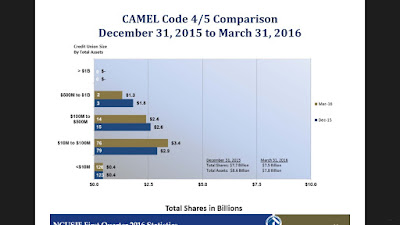
But that is a head scratcher, because there is one taxi medallion lending credit union with $1.9 billion in assets which has seen a clear deterioration in its performance.
Once again, this would suggest that reserves are understated.
So, are NCUSIF premium assessments in the offing?
According to the NCUA, the NCUSIF contingent liability is derived by using an internal econometric model that applies estimated failure and loss rates and takes into account the historical loss history, CAMEL ratings, credit union level financial ratios, and other conditions. In addition, specific analysis is performed on those insured credit unions where failure is imminent or where additional information is available that may affect the estimate of losses.
However, I believe NCUA may be underestimating the reserves needed to cover future losses to the NCUSIF, as past performance is not an indicator of future performance.
NCUA's internal econometric model might not accurately capture the estimated losses arising from the disruption of Uber and Lyft to taxi medallion lending credit unions.
The prices of taxi medallions -- the collateral backing the medallion loans -- have collapsed since the beginning of 2015.
This suggests that the loss rates to the NCUSIF from a failure of a taxi medallion lending credit union could be higher than past historical loss rates from other credit union failures.
In addition, at the end of the first quarter, there was not a single credit union with assets of at least $1 billion in assets with a CAMEL rating of 4 or 5.

But that is a head scratcher, because there is one taxi medallion lending credit union with $1.9 billion in assets which has seen a clear deterioration in its performance.
Once again, this would suggest that reserves are understated.
So, are NCUSIF premium assessments in the offing?
Tuesday, April 21, 2015
List of CUs that Would See An Increase in Share of NCUSIF Assessment Base
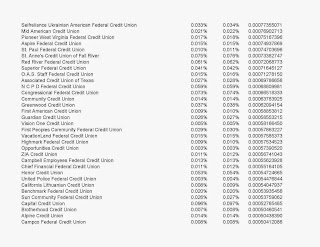
Below is a list of the 456 credit unions that would see an increase in their portion of the NCUSIF assessment base, if the assessment base shifted from insured shares and deposits to total assets minus net worth. The credit unions are ranked by largest change in share of NCUSIF assessment base (click on images to enlarge).




Wednesday, April 15, 2015
Distributional Impact of Changing Assessment Base.
In the NCUA's White Paper on National Credit Union Share Insurance Fund Improvements, the agency proposed changing the assessment base from insured shares and deposits to total assets minus net worth. Read my April 6 blog.
If this proposal was to become law, only 456 natural person credit unions would see their portion of the NCUSIF assessment base increase as of the end of 2014. This would mean these credit unions would pay higher deposit insurance premiums, if assessed and the aggregate premium payments are revenue neutral.
All other credit unions would either see a reduction or no change in their share of the NCUSIF assessment base.
Below is an analysis of credit unions by asset size that would see an increase their share of the NCUSIF assessment base.
Two credit unions with more than $10 billion in assets would see their portion of the NCUSIF assessment base increase with the change.
Eleven credit unions with assets between $5 billion and $10 billion would experience an increase in their portion of the NCUSIF assessment base.
For credit unions with assets between $1 billion and $5 billion, 86 credit unions would encounter an increase in their share of the NCUSIF assessment base.
The portion of the assessment base for 63 credit unions with assets between $500 million and $1 billion would increase.
Sixty-two credit unions with assets between $250 million and $500 million would experience an increase in their share of the assessment base.
For credit unions with between $100 million and $250 million, 85 would see their portion of the assessment base grow.
Finally, 147 small credit union would see an increase in their share of the NCUSIF assessment base.
If this proposal was to become law, only 456 natural person credit unions would see their portion of the NCUSIF assessment base increase as of the end of 2014. This would mean these credit unions would pay higher deposit insurance premiums, if assessed and the aggregate premium payments are revenue neutral.
All other credit unions would either see a reduction or no change in their share of the NCUSIF assessment base.
Below is an analysis of credit unions by asset size that would see an increase their share of the NCUSIF assessment base.
Two credit unions with more than $10 billion in assets would see their portion of the NCUSIF assessment base increase with the change.
Eleven credit unions with assets between $5 billion and $10 billion would experience an increase in their portion of the NCUSIF assessment base.
For credit unions with assets between $1 billion and $5 billion, 86 credit unions would encounter an increase in their share of the NCUSIF assessment base.
The portion of the assessment base for 63 credit unions with assets between $500 million and $1 billion would increase.
Sixty-two credit unions with assets between $250 million and $500 million would experience an increase in their share of the assessment base.
For credit unions with between $100 million and $250 million, 85 would see their portion of the assessment base grow.
Finally, 147 small credit union would see an increase in their share of the NCUSIF assessment base.
Monday, April 6, 2015
NCUA White Paper on Reforming the NCUSIF
A September 2013 NCUA White Paper sets forth the agency's recommendations for improving the National Credit Union Share Insurance Fund.
According to the White Paper, which was obtained through a Freedom of Information Act request, the National Credit Union Administration (NCUA) made the case for reform by stating that under current law it "does not have the appropriate flexibility necessary to manage the National Credit Union Share Insurance Fund (NCUSIF) in a manner consistent with the growing size and complexity of the credit union industry."
The 2013 White Paper made the following legislative recommendations to Congress.
Congress should approve legislation to remove the statutory cap from the NCUSIF equity ratio. Under current law, the normal operating level is set between 1.2 percent and 1.5 percent of insured shares (deposits) with the NCUA Board traditionally setting the normal operating level at 1.3 percent of insured shares. However, the agency has concluded that going forward a 1.3 percent equity ratio for the NCUSIF cannot be viewed as normal. The NCUA believes that "the NCUSIF needs an equity ratio of at least 2 percent to provide an asset base that would better enable the NCUSIF to withstand the types of pressure that arose during the recent financial crisis and recession." The agency estimated that the NCUSIF equity ratio needed to be at 2.17 percent of insured shares to prevent any depletion of a credit union's one percent NCUSIF capitalization deposit during the recent financial crisis and recession. In fact, I stated that this would be one possible NCUSIF reform in a January 8, 2014 blog post.
Congress should also amend the Federal Credit Union Act to enable NCUA to calculate premiums paid by insured credit unions based on assets minus net worth, rather than insured shares. NCUA wrote that basing premiums on total assets minus net worth would better account for the risks posed by highly leveraged institutions. The implication of shifting premiums to an asset minus net worth assessment base is that the share of premiums paid by larger credit unions and corporate credit unions would increase, while the premium burden for credit unions with less than $1 billion in assets would fall.
Furthermore, Congress should change the Federal Credit Union Act to enable the NCUA Board to develop a risk-based premium system for credit unions. Under current law, NCUA is required to assess NCUSIF premiums using a uniform percentage applied to the amount of insured deposits held by a credit union. NCUA wrote that by moving from a proportional to a risk-based premium system, this would increase both fairness and incentives for operating safely. In addition, the proposed legislative language submitted by NCUA would allow the Board to establish a different risk-based premium system for credit unions defined as small. However, the White Paper does not specify how the risk-based premiums will be calculated.
According to the White Paper, which was obtained through a Freedom of Information Act request, the National Credit Union Administration (NCUA) made the case for reform by stating that under current law it "does not have the appropriate flexibility necessary to manage the National Credit Union Share Insurance Fund (NCUSIF) in a manner consistent with the growing size and complexity of the credit union industry."
The 2013 White Paper made the following legislative recommendations to Congress.
Congress should approve legislation to remove the statutory cap from the NCUSIF equity ratio. Under current law, the normal operating level is set between 1.2 percent and 1.5 percent of insured shares (deposits) with the NCUA Board traditionally setting the normal operating level at 1.3 percent of insured shares. However, the agency has concluded that going forward a 1.3 percent equity ratio for the NCUSIF cannot be viewed as normal. The NCUA believes that "the NCUSIF needs an equity ratio of at least 2 percent to provide an asset base that would better enable the NCUSIF to withstand the types of pressure that arose during the recent financial crisis and recession." The agency estimated that the NCUSIF equity ratio needed to be at 2.17 percent of insured shares to prevent any depletion of a credit union's one percent NCUSIF capitalization deposit during the recent financial crisis and recession. In fact, I stated that this would be one possible NCUSIF reform in a January 8, 2014 blog post.
Congress should also amend the Federal Credit Union Act to enable NCUA to calculate premiums paid by insured credit unions based on assets minus net worth, rather than insured shares. NCUA wrote that basing premiums on total assets minus net worth would better account for the risks posed by highly leveraged institutions. The implication of shifting premiums to an asset minus net worth assessment base is that the share of premiums paid by larger credit unions and corporate credit unions would increase, while the premium burden for credit unions with less than $1 billion in assets would fall.
Furthermore, Congress should change the Federal Credit Union Act to enable the NCUA Board to develop a risk-based premium system for credit unions. Under current law, NCUA is required to assess NCUSIF premiums using a uniform percentage applied to the amount of insured deposits held by a credit union. NCUA wrote that by moving from a proportional to a risk-based premium system, this would increase both fairness and incentives for operating safely. In addition, the proposed legislative language submitted by NCUA would allow the Board to establish a different risk-based premium system for credit unions defined as small. However, the White Paper does not specify how the risk-based premiums will be calculated.
Thursday, November 20, 2014
Projected NCUSIF Premiums for 2015 Will Range Between 0 and 5 Basis Points
Credit union premiums to the NCUSIF will range between 0 and 5 basis points for 2015, according to a presentation to the NCUA Board.
However, credit unions will not be subject to any Temporary Corporate Credit Union Stabilization Fund assessments in 2015.
Review the slideshow.
However, credit unions will not be subject to any Temporary Corporate Credit Union Stabilization Fund assessments in 2015.
Review the slideshow.
Thursday, August 28, 2014
ASI Announces No Special Premium Assessment
American Mutual Share Insurance Corporation (ASI) announced to its member credit unions that there would be no Special Premium Assessment in 2014.
ASI noted that partial recoveries from its $26.4 million in capital assistance to Silver State Schools Credit Union (Las Vegas, NV) allowed the insurer to forgo a special assessment this year.
Read the press release.
ASI noted that partial recoveries from its $26.4 million in capital assistance to Silver State Schools Credit Union (Las Vegas, NV) allowed the insurer to forgo a special assessment this year.
Read the press release.
Tuesday, March 18, 2014
Projected TCCUSF Assessments Range From Minus $2 Billion to Minus $600 Million
Total projected assessments associated with the Temporary Corporate Credit Union Stabilization Fund declined $2.2 billion at the upper end between July and December 2013, the National Credit Union Administration announced today, the sharp drop due largely to the JPMorgan Chase settlement in November 2013.
The current projected range for total future remaining assessments is now between negative $2 billion and negative $600 million. At the end of the second quarter of 2013, the total range was negative $200 million to $1.6 billion. The overall rate of change in the assessment range is consistent with recent trends, and the continued improvement in the performance of the legacy assets underlying the NCUA Guaranteed Note program.
Read the press release.
The current projected range for total future remaining assessments is now between negative $2 billion and negative $600 million. At the end of the second quarter of 2013, the total range was negative $200 million to $1.6 billion. The overall rate of change in the assessment range is consistent with recent trends, and the continued improvement in the performance of the legacy assets underlying the NCUA Guaranteed Note program.
Read the press release.
Wednesday, February 12, 2014
Future Stabilization Fund Assessments Unlikely
The National Credit Union Administration (NCUA) announced that it is highly unlikely that credit unions will pay a future assessment to the Temporary Corporate Credit Union Stabilization Fund (TCCUSF).
NCUA cited the significant recoveries from legal settlements and the improvement in the performance of the underlying legacy assets of the NCUA Guaranteed Note program for the diminished prospect of future assessments.
According to the press release, the net remaining Stabilization Fund projected assessment range now runs from negative $1.9 billion to negative $400 million, compared to the negative $200 million to $1.6 billion projection from the second quarter of 2013.
However, NCUA cautions that the legacy asset cash flows have not been realized and could vary significantly from current projections.
In addition, the agency notes that it must still repay $2.9 billion in outstanding Treasury borrowings before any remaining Stabilization Fund distributions can be legally made to credit unions. As a result, any potential repayment to credit unions is not likely to occur prior to expiration of the Stabilization Fund in 2021.
Read the press release.
NCUA cited the significant recoveries from legal settlements and the improvement in the performance of the underlying legacy assets of the NCUA Guaranteed Note program for the diminished prospect of future assessments.
According to the press release, the net remaining Stabilization Fund projected assessment range now runs from negative $1.9 billion to negative $400 million, compared to the negative $200 million to $1.6 billion projection from the second quarter of 2013.
However, NCUA cautions that the legacy asset cash flows have not been realized and could vary significantly from current projections.
In addition, the agency notes that it must still repay $2.9 billion in outstanding Treasury borrowings before any remaining Stabilization Fund distributions can be legally made to credit unions. As a result, any potential repayment to credit unions is not likely to occur prior to expiration of the Stabilization Fund in 2021.
Read the press release.
Thursday, November 21, 2013
No TCCUSF Assessments for 2014
NCUA is reporting that there will be no Temporary Corporate Credit Union Stabilization Fund (TCCUSF) assessments for 2014.
NCUA staff has set the range of post-2013 TCCUSF assessments between minus $200 million and $1.6 billion.
In addition, NCUA announced that the range of NCUSIF assessments for 2014 will be between 0 and 5 basis points.

NCUA staff has set the range of post-2013 TCCUSF assessments between minus $200 million and $1.6 billion.
In addition, NCUA announced that the range of NCUSIF assessments for 2014 will be between 0 and 5 basis points.

Monday, September 9, 2013
ASI Announces Special Assessment for Privately Insured Credit Unions
Both Credit Union Journal and Credit Union Times are reprting that ASI Inc. of Dublin, Ohio announced a special premium assessment for 2013 of 7.5 basis points. In the past five years, ASI has assessed its members a total of 61.50 basis points. The ASI premium will be assessed of all privately insured credit unions of record with ASI as of September 30.
Thursday, July 25, 2013
Stabilization Fund Assessment at 8 Basis Points
NCUA announced that federally-insured credit unions will be assessed 8 basis points on insured deposits (shares) as of June 30, 2013. The assessment will raise approximately $700.9 million.
Federally-insured credit unions should expense the assessment in July and report the entire expense on the September 30, 2013 Call Report.
According to staff analysis, an assessment of 8 basis points will lower the annualized return on assets for federally-insured credit unions by 7 basis points. Based upon March 2013 data, an additional 328 federally-insured credit unions will slip from being profitable to having a negative core income.
In addition, NCUA stated that Net Worth Ratio for the industry will fall 6 basis points from 10.31 percent to 10.25 percent. Eight credit unions will become undercapitalized as their net worth ratio will fall below 6 percent due to the assessment and another 31 federally-insured credit unions will slip from being well-capitalized to adequately capitalized.
Furthermore, NCUA stated that the assessment of approximately $700.9 million will bring total Temporary Corporate Credit Union Stabilization Fund (TCCUSF) assessments to $4.8 billion. NCUA is projecting that the remaining TCCUSF assessments will range from $0.9 billion to $3.2 billion.
NCUA further announced that it will repay at least $650 million in TCCUSF borrowings in November. This will leave outstanding borrowings to Treasury at no more than $4.075 billion.
Read the board action item.
Federally-insured credit unions should expense the assessment in July and report the entire expense on the September 30, 2013 Call Report.
According to staff analysis, an assessment of 8 basis points will lower the annualized return on assets for federally-insured credit unions by 7 basis points. Based upon March 2013 data, an additional 328 federally-insured credit unions will slip from being profitable to having a negative core income.
In addition, NCUA stated that Net Worth Ratio for the industry will fall 6 basis points from 10.31 percent to 10.25 percent. Eight credit unions will become undercapitalized as their net worth ratio will fall below 6 percent due to the assessment and another 31 federally-insured credit unions will slip from being well-capitalized to adequately capitalized.
Furthermore, NCUA stated that the assessment of approximately $700.9 million will bring total Temporary Corporate Credit Union Stabilization Fund (TCCUSF) assessments to $4.8 billion. NCUA is projecting that the remaining TCCUSF assessments will range from $0.9 billion to $3.2 billion.
NCUA further announced that it will repay at least $650 million in TCCUSF borrowings in November. This will leave outstanding borrowings to Treasury at no more than $4.075 billion.
Read the board action item.
Wednesday, February 13, 2013
Controlled Experiment on Taxation (New Title)
In an op ed in The Gazette, Pat Jury, the head of the Iowa Credit Union League, wrote that "[i]ncreasing taxes on credit unions increases taxes on Iowa Credit Union members. Credit unions would have to pass along the increased expense to their members in the form of higher fees, higher loan rates and lower savings dividends."
However, Jury's opinion is not shared by some within the credit union industry.
Ed Speed, the former CEO of Texas Dow Employees Credit Union (TDECU), wrote the following in an August 10, 2011 guest opinion appearing in Credit Union Times.
So, the corporate assessment provides a controlled experiment to simulate the impact of taxation on the pricing of credit union services.
Did your credit union change loan or deposit rates and fees because of the corporate credit union assessment?
However, Jury's opinion is not shared by some within the credit union industry.
Ed Speed, the former CEO of Texas Dow Employees Credit Union (TDECU), wrote the following in an August 10, 2011 guest opinion appearing in Credit Union Times.
"The only impact taxation would have on TDECU is that we will double in size every seven years instead of every five years. So what?
The NCUA special assessments prove my point. Last year and for the next nine years, credit unions are paying special NCUA assessments, assessments that have just about the same impact as a 35% tax on credit union net income.
The assessments we paid - and will pay for the next decade - did not drive us to change loan and deposit rates and fees last year, nor will they in the future.
Paying a 35% tax on income would have the same impact on how we price: none, nada, zip."
So, the corporate assessment provides a controlled experiment to simulate the impact of taxation on the pricing of credit union services.
Did your credit union change loan or deposit rates and fees because of the corporate credit union assessment?
Subscribe to:
Posts (Atom)
