Richmond BizSense is reporting that Allegacy Federal Credit Union (Winston-Salem, NC) provided $6.5 million line of credit for a development project on the southside of Richmond, Virginia.
The project will redevelop the 15-acre Model Tobacco Company site and transform its main Art Deco-style building into a 275 income-based apartments.
Also, the developers are planning a 47,000-square-foot entertainment venue with a beer garden and restaurant space.
This is an illustration that large credit unions are venturing into financing larger commercial deals.
Read more.
Showing posts with label Commercial Real Estate Loans. Show all posts
Showing posts with label Commercial Real Estate Loans. Show all posts
Wednesday, June 24, 2020

Tuesday, April 28, 2020
Harper: CUs Entered Pandemic Recession in Strong Position, But Will Be Challenged
In a speech to the Mountain West Credit Union Association’s Annual Meeting on Thursday, April 23, National Credit Union Administration Board Member Todd Harper stated that federally insured credit unions entered the pandemic-induced recession in a strong position.
At the end of 2019, the system had a net worth ratio of 11.37 percent and a delinquency rate of just 71 basis points.
However, he cautioned that credit unions will face a challenging environment.
He noted that the COVID-19 pandemic will likely lead to sizable losses in the commercial real estate portfolio at credit unions. While the industry has an overall exposure to commercial real estate of 4.8 percent of the industry's assets, those credit unions that have concentrated in commercial real estate lending will be carefully monitored by the agency.
He further stated that residential real estate comprises 31 percent of the industry's balance sheet. Credit unions should expect elevated losses from higher rates of unemployment.
Credit unions hold $380 billion in auto loans. Harper told the audience that the agency expects auto loan delinquency rates to be high to very high, but he pointed out that credit union borrowers have better than average creditworthiness.
Harper noted that credit unions with large exposure in used auto loans could be challenged as used car prices plummet. He said: "These credit unions could face unexpectedly higher losses if the borrower defaults and the actual market price of the vehicle is lower than the value of the loan."
He also commented that these credit unions could face earnings pressure as both new and used car sales fall.
Harper stated that unsecured loans accounted for 7.5 percent of the industry's assets. Unsecured loans include credit cards, private student loans, and other unsecured products. Harper warned that if people don't return to work within the next 3 months, delinquencies on unsecured loans will start to hit credit unions.
Harper also encouraged credit unions to join the Central Liquidity Facility (CLF). He stated that even if your credit union does not borrow from the CLF, your joining the CLF will ensure that the CLF has the resources to meet the liquidity needs to other credit unions that are facing liquidity issues.
Read the speech
At the end of 2019, the system had a net worth ratio of 11.37 percent and a delinquency rate of just 71 basis points.
However, he cautioned that credit unions will face a challenging environment.
He noted that the COVID-19 pandemic will likely lead to sizable losses in the commercial real estate portfolio at credit unions. While the industry has an overall exposure to commercial real estate of 4.8 percent of the industry's assets, those credit unions that have concentrated in commercial real estate lending will be carefully monitored by the agency.
He further stated that residential real estate comprises 31 percent of the industry's balance sheet. Credit unions should expect elevated losses from higher rates of unemployment.
Credit unions hold $380 billion in auto loans. Harper told the audience that the agency expects auto loan delinquency rates to be high to very high, but he pointed out that credit union borrowers have better than average creditworthiness.
Harper noted that credit unions with large exposure in used auto loans could be challenged as used car prices plummet. He said: "These credit unions could face unexpectedly higher losses if the borrower defaults and the actual market price of the vehicle is lower than the value of the loan."
He also commented that these credit unions could face earnings pressure as both new and used car sales fall.
Harper stated that unsecured loans accounted for 7.5 percent of the industry's assets. Unsecured loans include credit cards, private student loans, and other unsecured products. Harper warned that if people don't return to work within the next 3 months, delinquencies on unsecured loans will start to hit credit unions.
Harper also encouraged credit unions to join the Central Liquidity Facility (CLF). He stated that even if your credit union does not borrow from the CLF, your joining the CLF will ensure that the CLF has the resources to meet the liquidity needs to other credit unions that are facing liquidity issues.
Read the speech
Tuesday, January 28, 2020
Bethpage FCU Provides $27.5 Million Loan to Refi Student Housing at University of Maryland
The Commercial Observer is reporting that Bethpage Federal Credit Union (Bethpage, NY) provided a $27.5 million loan to Columbia, Md.-based Star Global Ventures to refinance student housing property at the University of Maryland.
The 10-year, non-recourse debt pays interest at a fixed rate of 4.5 percent, according to sources. The loan-to-value ratio was 60 percent — established over a 1.25x debt service coverage ratio — indicating that the asset’s value is approximately $49 million.
This commercial real estate loan should cause policymakers to rethink the tax exemption of large credit unions.
Read more.
The 10-year, non-recourse debt pays interest at a fixed rate of 4.5 percent, according to sources. The loan-to-value ratio was 60 percent — established over a 1.25x debt service coverage ratio — indicating that the asset’s value is approximately $49 million.
This commercial real estate loan should cause policymakers to rethink the tax exemption of large credit unions.
Read more.
Sunday, September 1, 2019
Alliant CU Provides $12.1 Million in Commercial Real Estate Financing
Alliant Credit Union (Chicago, IL) refinanced three-property self-storage portfolio for the principal amount of $12.1 million.
According to RE Journal, the properties in Evansville (IN) and Pine Bluff (AR) encompass 1,565 total units, including a mix of standard units, climate-controlled units and outdoor vehicle storage.
Read the story.
According to RE Journal, the properties in Evansville (IN) and Pine Bluff (AR) encompass 1,565 total units, including a mix of standard units, climate-controlled units and outdoor vehicle storage.
Read the story.
Thursday, August 8, 2019
Technology CU Provided $4.675 Million USDA Business Loan to Buy Boutique Hotel
Technology Credit Union (San Jose, CA) announced it has provided a $4.675 million USDA guaranteed business loan to Oceanic Enterprises, a private property management firm based in San Diego, California.
The loan helped Oceanic Enterprises purchase The Ascot Suites, a 32-room boutique hotel located in Morro Bay, California.
Read more.
The loan helped Oceanic Enterprises purchase The Ascot Suites, a 32-room boutique hotel located in Morro Bay, California.
Read more.
Monday, May 13, 2019
Opinion Piece Critical of NCUA's Proposed Appraisal Threshold Rule
The National Credit Union Administration Board's proposal to quadruple the appraisal threshold for nonresidential real estate loans to $1 million could significantly undermines the safety and soundness of the commercial lending market, according to an op-ed in the American Banker.
In a BankThink piece, Stephen Wagner, the president of the Appraisal Institute, expressed deep concerns regarding this proposed rule.
Wagner wrote that increasing the appraisal threshold to $1 million "would drastically increase the number of nonresidential real estate loans that would not require an appraisal."
He worries that this would result in a lower level of risk mitigation and will create an environment of loan driven-production.
Wagner points out that NCUA's threshold would be double that of the other federal banking regulators at $500,000 and he believes that this could cause bank regulators to further relax their appraisal requirements.
Wagner also expressed concern about the lack of experience of NCUA regulating commercial real estate loans. He wrote that NCUA is "the agency with the least direct experience in overseeing business and commercial real estate lending," but it will be driving appraisal policies for the entire financial regulatory system.
Read the BankThink piece.
In a BankThink piece, Stephen Wagner, the president of the Appraisal Institute, expressed deep concerns regarding this proposed rule.
Wagner wrote that increasing the appraisal threshold to $1 million "would drastically increase the number of nonresidential real estate loans that would not require an appraisal."
He worries that this would result in a lower level of risk mitigation and will create an environment of loan driven-production.
Wagner points out that NCUA's threshold would be double that of the other federal banking regulators at $500,000 and he believes that this could cause bank regulators to further relax their appraisal requirements.
Wagner also expressed concern about the lack of experience of NCUA regulating commercial real estate loans. He wrote that NCUA is "the agency with the least direct experience in overseeing business and commercial real estate lending," but it will be driving appraisal policies for the entire financial regulatory system.
Read the BankThink piece.
Friday, October 12, 2018
Community Banks View CUs as Primary Competitor for Consumer Loans
Community banks view credit unions as their primary competitor for consumer loans, according to a survey.
The survey was conducted by the Federal Reserve and the Conference of State Bank Supervisors.
The survey found that 41.3 percent of community banks stated that credit unions are currently their primary competitor for consumer loans. Survey respondents believe credit unions will in the future be their primary competitor for consumer loans (35.6 percent).
With regard to mortgage loans, 13.5 percent of community banks identified credit unions as their current primary competitor. In the future, 13 percent of community banks expect credit unions to be their primary competitor.
Only 5.5 percent of community banks view credit unions as a primary competitor for small business loans. However, the expectations is for competition from credit unions in small business lending to grow as 10.7 percent identified credit unions as their primary future competitors.
Only 3.3 percent of community banks identify credit unions as their primary competitor for commercial real estate loans. In the future, 6.9 percent of community banks believe credit unions will be their primary competitor for commercial real estate loans.
With regard to agricultural loans, banks don't view credit unions as a primary competitor in the present or the future.
Read the survey report.
The survey was conducted by the Federal Reserve and the Conference of State Bank Supervisors.
The survey found that 41.3 percent of community banks stated that credit unions are currently their primary competitor for consumer loans. Survey respondents believe credit unions will in the future be their primary competitor for consumer loans (35.6 percent).
With regard to mortgage loans, 13.5 percent of community banks identified credit unions as their current primary competitor. In the future, 13 percent of community banks expect credit unions to be their primary competitor.
Only 5.5 percent of community banks view credit unions as a primary competitor for small business loans. However, the expectations is for competition from credit unions in small business lending to grow as 10.7 percent identified credit unions as their primary future competitors.
Only 3.3 percent of community banks identify credit unions as their primary competitor for commercial real estate loans. In the future, 6.9 percent of community banks believe credit unions will be their primary competitor for commercial real estate loans.
With regard to agricultural loans, banks don't view credit unions as a primary competitor in the present or the future.
Read the survey report.
Friday, September 14, 2018
Technology CU Funds $20.5 Million Construction Loan
Technology Credit Union (San Jose, CA) provided a $20.5 million construction loan for a luxury apartment development.
The loan will fund the development of a four-story, 55-unit luxury apartment building with a one-story parking garage.
This is a large loan and indicates that large credit unions and banks are competing for the same commercial customers.
Read the press release.
The loan will fund the development of a four-story, 55-unit luxury apartment building with a one-story parking garage.
This is a large loan and indicates that large credit unions and banks are competing for the same commercial customers.
Read the press release.
Friday, October 6, 2017
Bethpage FCU Provides $20 Million Loan for Staten Island Shopping Center
Bethpage Federal Credit Union provided $20 million refinancing loan to Staten Island Expressway Plaza shopping center.
The loan is for seven years.
Westbury-based Kalikow Group and New Canaan, Connecticut-based Feldco Development received the loan.
Read the story.
The loan is for seven years.
Westbury-based Kalikow Group and New Canaan, Connecticut-based Feldco Development received the loan.
Read the story.
Wednesday, September 27, 2017
Tech CU Funds $3 Million Commercial Real Estate Loan
Technology Credit Union (San Jose, CA) on September 5 announced that it was originating a $3 million commercial real estate loan.
The loan will assist infunding the purchase of a 12,800 square foot, Class B commercial property in downtown San Jose, as well as provide for minor tenant improvement work and miscellaneous expenditures.
Technology Credit Union will finance commercial real estate loans up to $15 million.
Read the press release.
The loan will assist infunding the purchase of a 12,800 square foot, Class B commercial property in downtown San Jose, as well as provide for minor tenant improvement work and miscellaneous expenditures.
Technology Credit Union will finance commercial real estate loans up to $15 million.
Read the press release.
Sunday, April 10, 2016
Bethpage Refinances Medical Office Building
Bethpage Federal Credit Union (Bethpage, NY) provided a $28 million commercial mortgage to refinance an eight-story 72,000-square-foot medical office building in Brooklyn.
New York developer David Marx of Marx Development Group received the loan.
The loan has a five-year term with a fixed-rate of 4.25 percent.
To date, this is the largest loan to be closed by Bethpage Federal Credit Union.
Do real estate developers need taxpayer subsidized loans?
Read the story.
New York developer David Marx of Marx Development Group received the loan.
The loan has a five-year term with a fixed-rate of 4.25 percent.
To date, this is the largest loan to be closed by Bethpage Federal Credit Union.
Do real estate developers need taxpayer subsidized loans?
Read the story.
Friday, March 18, 2016
Technology CU Finances $22.4 Million SBA 504 Loan
Technology Credit Union (San Jose, CA) announced on March 17 that the credit union has funded its largest Small Business Administration (SBA) 504 loan to date at $22.4 million.
The loan provided financing to assist a commercial tenant’s purchase of a 112,000 square-foot, multi-tenant office building located in Burlingame, California.
According to the press release, the $2 billion credit union has originated over $300 million in commercial loan commitments to more than 120 middle market businesses.
Read the press release.
The loan provided financing to assist a commercial tenant’s purchase of a 112,000 square-foot, multi-tenant office building located in Burlingame, California.
According to the press release, the $2 billion credit union has originated over $300 million in commercial loan commitments to more than 120 middle market businesses.
Read the press release.
Tuesday, December 22, 2015
Large CUs' Real Estate Secured Business Loan Exposures
On December 18, the federal banking agencies -- the Federal Deposit Insurance Corporation, the Federal Reserve, and the Office of the Comptroller of the Currency -- issued a statement warning about eased commercial real estate (CRE) loan underwriting and CRE risk management practices that cause “concern.” The federal banking regulators added that supervisors will “continue to pay special attention” to CRE lending in exams in 2016 and reiterated existing interagency guidance on CRE concentration risk.
The National Credit Union Administration did not sign on to this statement; but NCUA may want to sign on to the interagency guidance on CRE concentration risk as real estate secured business loans continue to expand.
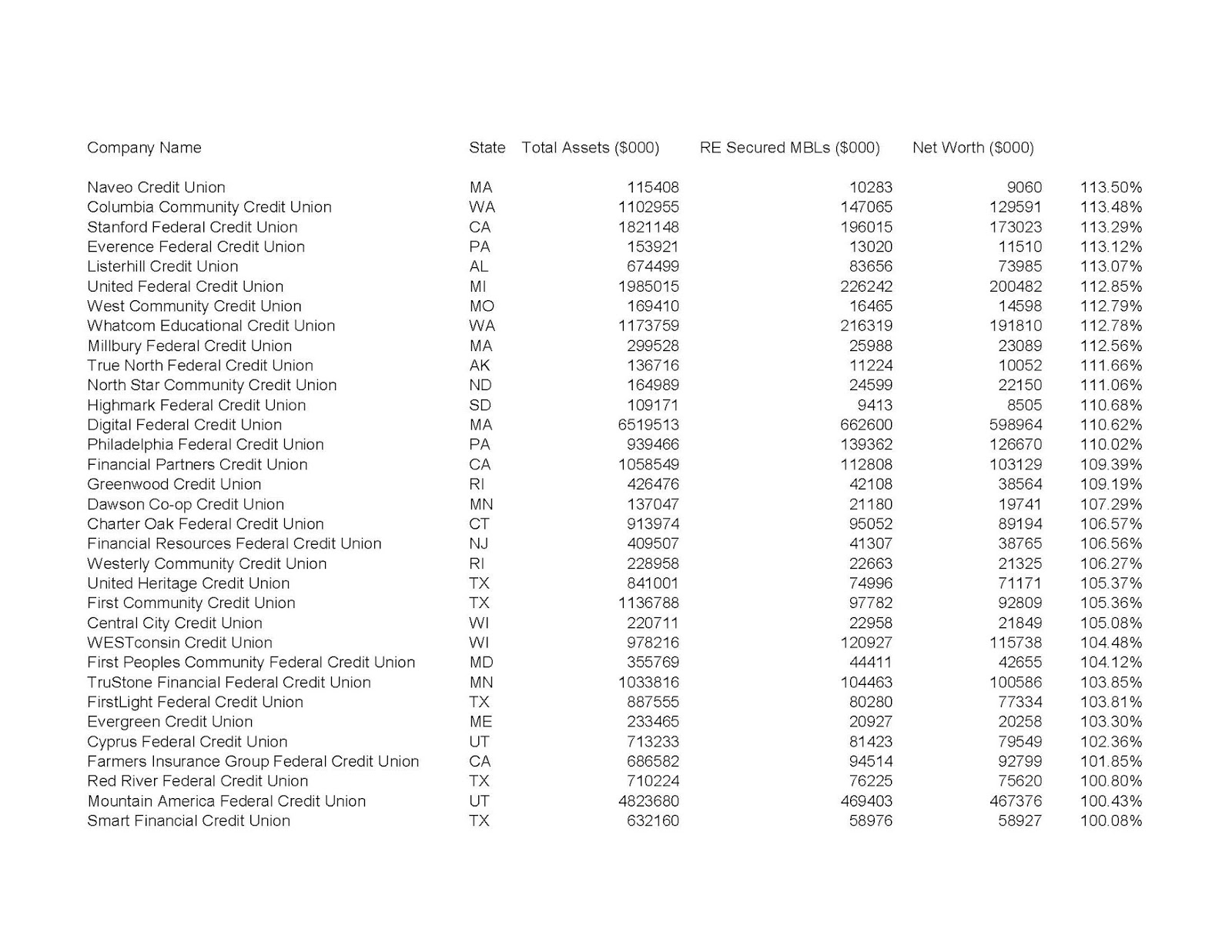
There are 105 credit unions with assets of at least $100 million that have an aggregate exposure to real estate secured business loans that exceeds their net worth at the end of the third quarter.
[Editorial note: I know the 105 credit unions include credit unions that have exposure to farmland loans; but the recent weakness in farm commodity prices will likely have a negative impact on farmland values. So, those credit unions making farmland loans also warrant careful monitoring.]
Thirteen credit unions have a real estate secured business loan to net worth ratio above 200 percent and 5 credit unions -- all state charters -- have a real estate secured business loan to net worth ratio in excess of 300 percent.
The two credit unions with the greatest net worth exposure to real estate secured business loans are involved in church financing. Evangelical Christian Credit Union (Brea, CA) has the greatest percentage of its net worth exposed to real estate secured business loans at 907.24 percent. America's Christian Credit Union (Glendora, CA) has the next largest exposure at 532.4 percent.
The following tables provides info on credit unions with real estate secured business loan exposures of at least 100 percent of net worth.


Read the statement.
The National Credit Union Administration did not sign on to this statement; but NCUA may want to sign on to the interagency guidance on CRE concentration risk as real estate secured business loans continue to expand.
There are 105 credit unions with assets of at least $100 million that have an aggregate exposure to real estate secured business loans that exceeds their net worth at the end of the third quarter.
[Editorial note: I know the 105 credit unions include credit unions that have exposure to farmland loans; but the recent weakness in farm commodity prices will likely have a negative impact on farmland values. So, those credit unions making farmland loans also warrant careful monitoring.]
Thirteen credit unions have a real estate secured business loan to net worth ratio above 200 percent and 5 credit unions -- all state charters -- have a real estate secured business loan to net worth ratio in excess of 300 percent.
The two credit unions with the greatest net worth exposure to real estate secured business loans are involved in church financing. Evangelical Christian Credit Union (Brea, CA) has the greatest percentage of its net worth exposed to real estate secured business loans at 907.24 percent. America's Christian Credit Union (Glendora, CA) has the next largest exposure at 532.4 percent.
The following tables provides info on credit unions with real estate secured business loan exposures of at least 100 percent of net worth.


Read the statement.
Friday, October 25, 2013
Credit Unions as Stealth CRE Lenders
An article in GlobeSt.com talks about the growth of credit unions as commercial real estate (CRE) lenders.
The article cites the expansion of CRE lending at NASA Federal Credit Union. According to Andy Stafford, director of Commercial Real Estate at NASA Federal Credit Union, commercial real estate lending at NASA Federal Credit Union is expected to increase by 30 percent to 35 percent in 2013.
The article notes that these loans are not micro transactions; but rather loans ranging in size from $1 million to more than $20 million.
The use of a credit union service organization makes it possible for the credit union to finance larger commercial real estate loans by partnering with other credit unions.
But should we as a society be providing taxpayer subsidized loans to fund commercial real estate projects?
Read the article.
The article cites the expansion of CRE lending at NASA Federal Credit Union. According to Andy Stafford, director of Commercial Real Estate at NASA Federal Credit Union, commercial real estate lending at NASA Federal Credit Union is expected to increase by 30 percent to 35 percent in 2013.
The article notes that these loans are not micro transactions; but rather loans ranging in size from $1 million to more than $20 million.
The use of a credit union service organization makes it possible for the credit union to finance larger commercial real estate loans by partnering with other credit unions.
But should we as a society be providing taxpayer subsidized loans to fund commercial real estate projects?
Read the article.
Friday, June 22, 2012
Credit Union CEOs Testify at House Small Business Hearing
At a House Small Business subcommittee hearing yesterday, two credit union CEOs from institutions with about $2 billion in assets (larger than almost 95% of banks) testified regarding raising the credit union member business lending cap. These credit unions represent the few overly aggressive credit unions wishing to take advantage of their tax-exempt status and move further from their mandated mission of helping those of modest means.
These CEOs do not represent the majority of credit unions. Over 71% of credit unions do not make any business loans, and of those who do, most are not near the lending cap.
Further, their testimonies indicate that these credit unions are interested in making larger commercial loans ranging from $0.5 million to $3.8 million, not loans to small businesses.
Credit unions may already make business loans less than $50,000 without it counting towards their business lending cap. In addition, Small Business Administration guaranteed loans, many guaranteed at 85% of a loan amount, do not count towards the existing cap.
S. 2231 and H.R. 1418 will add to the federal deficit and disadvantage community banks. These bills will permit a few credit unions to cherrypick existing business loan customers from community banks—who pay taxes.
Ultimately, these bills would allow credit unions to look and act like banks without the obligation to pay taxes or have bank-like regulatory requirements, such as the Community Reinvestment Act, applied to them.
If some credit unions have outgrown their charter, they should switch to a bank charter.
Read more about the hearing.
These CEOs do not represent the majority of credit unions. Over 71% of credit unions do not make any business loans, and of those who do, most are not near the lending cap.
Further, their testimonies indicate that these credit unions are interested in making larger commercial loans ranging from $0.5 million to $3.8 million, not loans to small businesses.
Credit unions may already make business loans less than $50,000 without it counting towards their business lending cap. In addition, Small Business Administration guaranteed loans, many guaranteed at 85% of a loan amount, do not count towards the existing cap.
S. 2231 and H.R. 1418 will add to the federal deficit and disadvantage community banks. These bills will permit a few credit unions to cherrypick existing business loan customers from community banks—who pay taxes.
Ultimately, these bills would allow credit unions to look and act like banks without the obligation to pay taxes or have bank-like regulatory requirements, such as the Community Reinvestment Act, applied to them.
If some credit unions have outgrown their charter, they should switch to a bank charter.
Read more about the hearing.
Wednesday, April 21, 2010
Fifty CUs with Largest CRE Loan Portfolios
At the end of 2009, federally-insured credit unions held approximately $27.6 billion in commercial real estate (CRE) loans. CRE loans accounted for almost 80 percent of all credit union business loans.
Below is a table showing the 50 credit unions with the largest CRE loan portfolios as of December 2009. The table also includes information on CRE loans as a percent of the credit union's net worth, which provides a measure of concentration risk at the credit union to commercial real estate (click to enlarge image).
Evangelical Christian CU (CA) held the top ranking and reported holding slightly more than $1 billion in commercial real estate loans at the end of 2009. Rounding out the top 5 are America First (UT) with $541 million in CRE loans, San Diego County (CA) with $469 million in CRE loans, Kinecta (CA) with almost $400 million in commercial mortgages, and Patelco (CA) with $381 million in CRE loans.

Below is a table showing the 50 credit unions with the largest CRE loan portfolios as of December 2009. The table also includes information on CRE loans as a percent of the credit union's net worth, which provides a measure of concentration risk at the credit union to commercial real estate (click to enlarge image).
Evangelical Christian CU (CA) held the top ranking and reported holding slightly more than $1 billion in commercial real estate loans at the end of 2009. Rounding out the top 5 are America First (UT) with $541 million in CRE loans, San Diego County (CA) with $469 million in CRE loans, Kinecta (CA) with almost $400 million in commercial mortgages, and Patelco (CA) with $381 million in CRE loans.

Subscribe to:
Posts (Atom)